

Top
Author
Updated
12 Dec 2025Form Number
LP1992PDF size
35 pages, 2.4 MBSubscribed to LP1992.
Thank you for your feedback.
Table of Contents
Abstract
Lenovo XClarity One is a versatile, unified management platform designed to simplify the administration of Lenovo servers. Available to be implemented as Hybrid cloud-based or on-premises local VM versions, this solution offers a consistent, user-friendly interface for monitoring, managing, and optimizing data center resources. With advanced automation capabilities, XClarity One centralizes and streamlines routine tasks, reduces operational complexity, and enhances system performance.
Whether deployed in the cloud or on-premises, XClarity One provides scalability, flexibility, and remote access, ensuring high availability and reliability for IT infrastructure. Ideal for businesses of all sizes, XClarity One delivers the tools and insights needed to drive operational efficiency and support business growth.
This product guide provides essential presales information to understand the Lenovo XClarity One offering, its components, key features, specifications, and compatibility. This guide is intended for technical specialists, sales specialists, sales engineers, IT architects, and other IT professionals who want to learn more about XClarity One and consider its use in IT solutions.
Change History
Changes in the December 12, 2025 update:
- Updates based on December 2025 release of XClarity One components
- XClarity One On Premise implementation - Implementing XClarity One section
- Name change of XClarity Management Hub to XClarity One Hub
- Update Supported XClarity Management Hub 2.0 Host Environments - Host requirements section
- Additional information regarding licensing - Ordering XClarity One section
- Added the new Trial license - Evaluating XClarity One section
- Added information on XClarity One On-Premise implementation - Requirements for XClarity One On Premise Portal section
- Added topics to the Using XClarity One section
- Added topics to the Management tasks section
Introduction
XClarity One is the next milestone in Lenovo’s portfolio of systems management products. Now you can leverage the benefits of a true next-generation, hybrid cloud-based or on-premise solution for the deployment, management, and maintenance of your infrastructure through a single, agentless, and centralized platform that delivers a consistent user experience across supported Lenovo products.
XClarity One provides a modern, intuitive interface that centralizes IT orchestration tasks such as deployment, automation, configuration and provisioning of firmware updates. It provides support from edge to cloud, via the use of local secure management hubs across multiple sites to communicate with all the managed devices to collect inventory, view incidents, and collect service data, and to provision resources with enhanced visibility into infrastructure performance, usage metering, and analytics.
Did you know?
XClarity One is designed to know what you need before you need it, and to improve operational efficiency while keeping your data and devices secure from external threats. The predictive analytics engines swiftly identify potential issues and minimize system downtime by accurately pinpointing any vulnerabilities and problems without unnecessary component replacements. You can also provide feedback on XClarity One via the web console interface.
XClarity One is also now available to be implemented On Premise: XClarity One can be deployed in your data center as a virtual machine on a local host.
Components of XClarity One
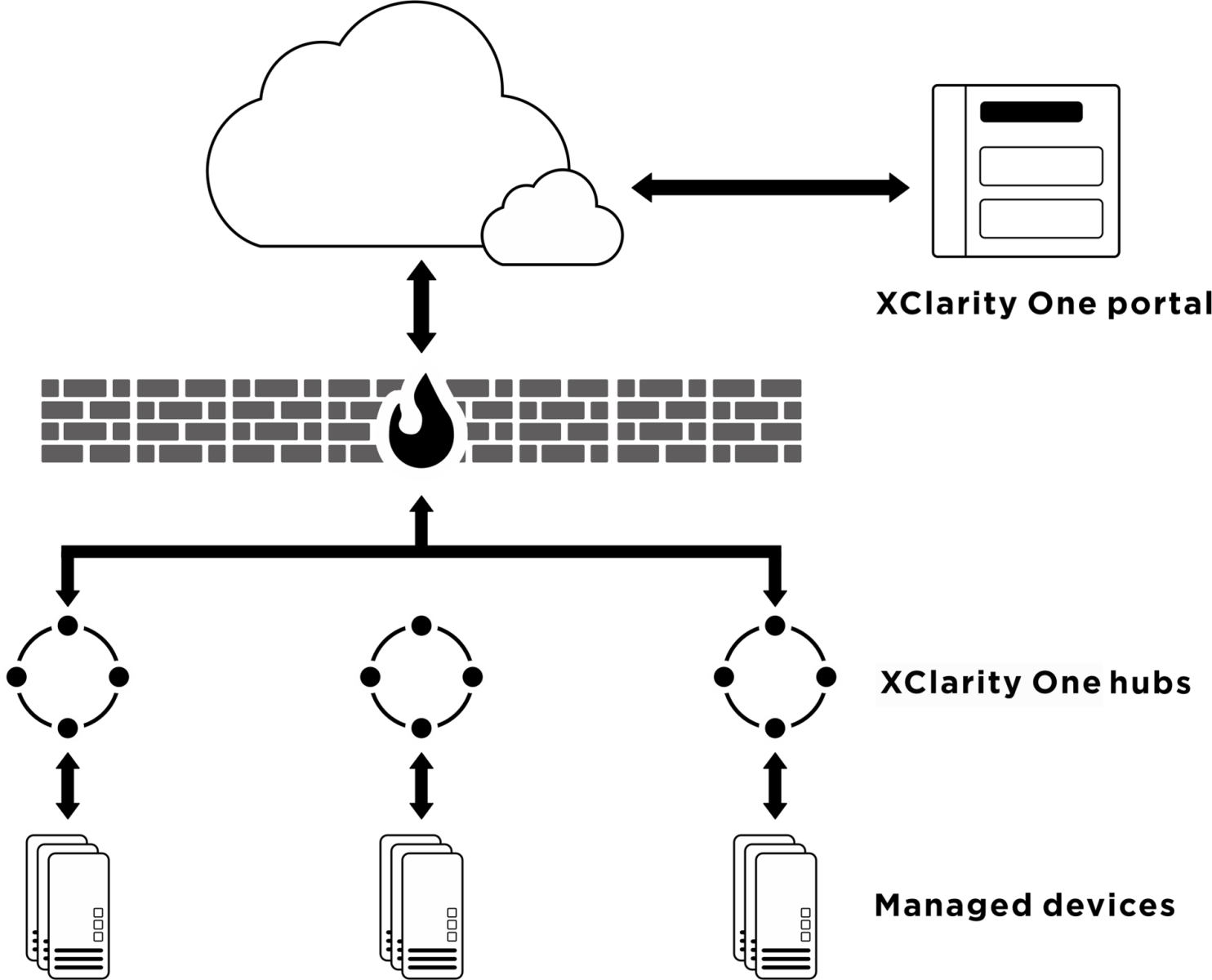
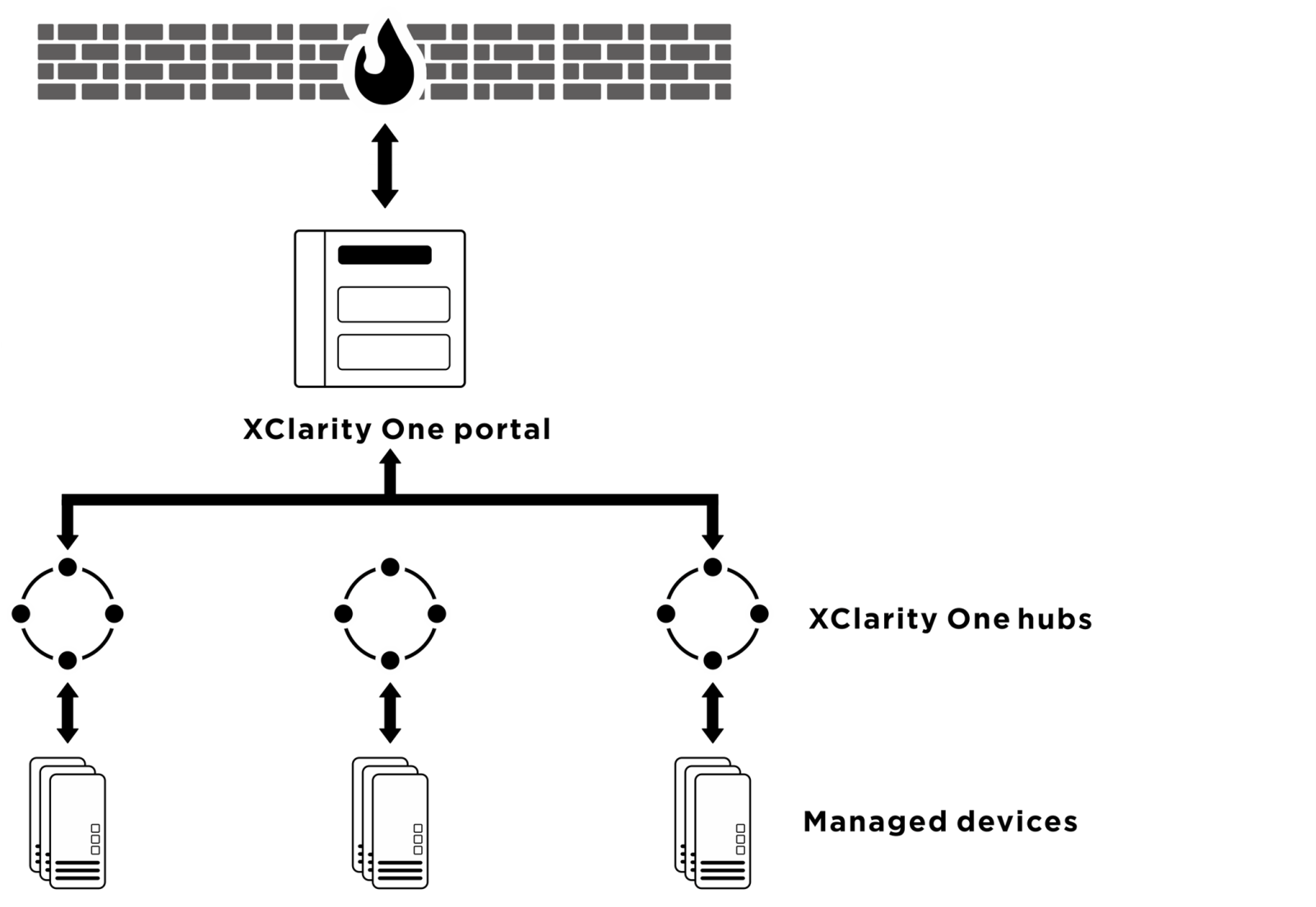
Lenovo XClarity One Portal is the main interface for the XClarity One solution, the XClarity One Portal can be in the Cloud or implemented On-Premise, the XClarity One Portal monitors and manages devices through one or more lightweight device managers called XCarity One Hubs
The XClarity One Hubs are installed as lightweight Virtual Appliances on premise in data centers across multiple sites, where devices to be managed are located. The XClarity One Hubs act as secure bridges between your devices and the XClarity One Portal. The XClarity One hub reduces your security risk through using only a single secure connection between the XClarity One Portal and on-premises/private cloud-managed devices.
Maximum devices: The maximum number of managed devices per XClarity One Hub depends on how XClarity One is implemented:
- When used in conjunction with XClarity One Portal as a local VM, each XClarity One Hub supports a maximum of 1,000 managed devices.
- When used in conjunction with XClarity One Portal in the cloud, each XClarity One Hub supports a maximum of 5,000 managed devices
Implementing XClarity One
XClarity One can now be implemented in two ways, as shown below:
- Hosted in the Lenovo cloud with XClarity One Cloud based Portal and On-Premise XClarity One Hubs, or
- XClarity One can be implemented as a a fully On-Premise solution.
| XClarity One Hybrid Cloud implementation | XClarity One On Premise implementation |
|---|---|
 |
 |
XClarity One Hybrid cloud implementation is recommended for small to medium businesses that desire enterprise-grade capabilities without the heavy upfront investments and IT overhead and for management service providers (MSPs).
The advantages of using XClarity One in the cloud are as follows:
- Lenovo hosts, manages and maintains the XClarity One environment for you
- Software updates are installed as soon as released
- Security fixes and software updates are installed as soon as possible, once released
- Customer fixes are installed as soon as possible, depending on the severity
- Latest Lenovo firmware updates are uploaded as soon as they are released
- High service level objectives (SLOs)
When implementing XClarity One On Premise the functions below will require an Internet connection:
- Automatic problem notification through Call Home
- Service ticket status and history
- Device warranty
- Lenovo firmware CVE analysis
Ordering information and downloads
In this section we cover the following topics:
Ordering XClarity One
XClarity One is a for-fee cloud or virtual machine offering. You must acquire appropriate licenses to use XClarity One. XClarity One is licensed per managed device and is available for 1,3 or 5 year terms. See the following table for ordering information for XClarity One.
DCSC tip: Currently, when using the DCSC configurator, XClarity Pro licenses should be deselected before selecting XClarity One Licenses.
Licensing notes:
- You need to order a license per physical managed device.
- There is no restriction on the number of licenses you can purchase for the trial ,although please be aware of the guidelines depending on the installation:
- When used in conjunction with XClarity One in the cloud, Each XClarity One Hub supports a maximum of 5,000managed devices.
- When used in conjunction with XClarity One as a local VM, Each XClarity One Hub supports a maximum of 1,000managed devices.
- Licenses are tied to specific organizations but are not tied to specific managed devices in the organization.
- Ensure that the customer number used to purchase the licenses matches the customer number for the organization.
Once XClarity One is purchased, the customer will receive a POE (Proof of Entitlement) email. The email contains the customer number and URL needed to register for usage of the XClarity One product. Once you register, you will be given instructions on how to proceed.
Evaluating XClarity One
If you are looking to evaluate XClarity One, by default you can use XClarity One for free to manage a maximum of 50 devices for up to 30 days using the included evaluation license, however note that this evaluation license does not include Technical Support Entitlement. After the evaluation license expires, you must purchase and install appropriate licenses as described in the section above to continue using XClarity One functions and to get XClarity One service and Technical Support.
As an alternative, for a limited time, Lenovo is offering customers an opportunity to gain access to a a 1 Year Trial Licenses which includes support entitlement free of charge. This is ideal for customers looking to evaluate XClarity One for an extended time or to get started with XClarity One, this license was released on 1st October 2025 and is available to purchase until the end of 2025.
DCSC tip: When using the DCSC configurator, XClarity Pro licenses should be deselected before selecting XClarity One Licenses.
The following table shows the ordering information for the 1 Year Trial License, Available until the end of December 2025.
Important notes about the XClarity One Trial:
- You need to order a license per Physical Managed device.
- There is no restriction on the number of licenses you can purchase for the trial. Although please be aware of the guidelines depending on the installation:
- When used in conjunction with XClarity One in the cloud, Each XClarity One Hub supports a maximum of 5,000
- When used in conjunction with XClarity One as a local VM, Each XClarity One Hub supports a maximum of 1,000
- Licenses are tied to specific organizations but are not tied to specific managed devices in the organization.
- Ensure that the customer number used to purchase the licenses matches the customer number for the organization.
- After the trial period of 1 year has expired, customer would require to purchase XClarity One licensing according to their managed environment. At this point the licenses they must purchase are detailed in section Ordering XClarity One
Downloading XClarity One
Depending on how you are implementing XClarity One, please see URL links below for the various components:
- XClarity One Cloud portal
- Available at the following URL: https://xclarityone.lenovo.com/
- For more information on how to setup XClarity One in the Cloud see:
http:// https://pubs.lenovo.com/lxc1/getstarted-cloud
- XClarity One Portal for installation as a Virtual Machine On-Premise
- Download from the following URL: https://support.lenovo.com/solutions/lnvo-xc1
- For more information on how to configure XClarity One as a virtual Machine see:
https://pubs.lenovo.com/lxc1/getstarted-onprem
- XClarity One Hub
- Download from the following URL: https://support.lenovo.com/solutions/lnvo-xc1
- For more information on how to setup XClarity One Hub see:
https://pubs.lenovo.com/lxc1/hub-setupTsa
Requirements for XClarity One On Premise Portal (Virtual Machine)
XClarity One On-Premise Portal runs as a virtual appliance on a host system that is installed locally in your datacenter. The following requirements must be met:
Host requirements
The following hypervisors are supported for running XClarity One as a virtual appliance.
- VMware ESXi 8.0 or later (.ova)
Hardware requirements
The following table lists the minimum recommended configurations for the XClarity One virtual appliance based on the number of managed devices. Depending on your environment and use of provisioning functions (such as firmware updates and device settings), additional resources might be needed for optimal performance.
- 8 virtual processor cores
- 16 GB memory
- 768 GB storage, across two attached disks.
- 256 GB minimum for the virtual appliance (disk 0)
- 512 GB minimum for the repository (disk 1)
For the latest information on installing and configuring XClarity One On-Premise Portal refer to the following link: https://pubs.lenovo.com/lxc1/getstarted-onprem
Requirements for XClarity One Hub
Lenovo XClarity One Hub runs as a virtual appliance on a host system that is installed locally in your data center.
The following requirements must be met.
Supported host environment
The following are the supported host operating systems for XClarity One Hub:
- VMware ESXi 8.0 or later (.ova)
- Microsoft Windows Server 2022 or 2025 with Hyper-V (.vhdx)
- Ubuntu 22.04 LTS and 24.04 LTS (.qcow2)
- Proxmox 9.0 (.qcow2)
- Nutanix Stack 7.0 (.qcow2)
Host resource requirements
The following table lists the minimum recommended configurations for XClarity One Hub based on the number of managed devices. Depending on your environment (such as firmware updates, and server configuration), additional resources might be needed for optimal performance.
| Number of managed devices | Virtual processors | Memory (GB) | Storage (GB) |
|---|---|---|---|
| 1 - 100 | 1 | 4 GB | 320 GB |
| 101 - 2,000 | 3 | 8 GB | 320GB |
| 2,001 - 5,000 | 6 | 16 GB | 320GB |
NTP Server
A Network Time Protocol (NTP) server is required to ensure that timestamps for all events and alerts that are received from managed devices are synchronized with XClarity One Hub. Ensure that the NTP server is accessible over the management network (typically the Eth0 interface).
For the latest information on installing and configuring the XClarity One Hub refer to:
https://pubs.lenovo.com/lxc1/hub-setup
Supported endpoints
As detailed previously XClarity One portal manages devices via the XClarity One Hub. For a complete list of supported devices see: https://support.lenovo.com/solutions/HT516492
Web browsers
The XClarity One Hub web interface works with the following web browsers.
- Chrome 115 or later
- Firefox ESR 102.12 or later
- Microsoft Edge 115 or later
- Safari 16.6 or later
For the latest information on installing and configuring XClarity One Hub refer to the following link: https://pubs.lenovo.com/lxc1/hub-setup.
Security
Lenovo is committed to security, XClarity One is designed with security as integral to the overall solution and seamless to the end-user experience. The solution is built with the premise of zero trust as a guiding strategy. Every component across the data flow is protected using best-in-breed security practices. End-to-end encryption provides the bedrock of the trust-but-verify architecture where every action is authenticated and authorized, both for users, and for machine-to-machine communication.
Security in the Software Development Lifecycle provides continuous and immediate feedback to ensure the solution is built as securely as possible. Leveraging cloud security controls from the XClarity One Cloud Service Provider, Microsoft Azure, the infrastructure running the solution workload is tightened to ensure the environment does not expose the solution to lateral attack. White Hat penetration testers regularly attack the environment from within and without, providing solid protection for customer data and control of customer critical data-center systems.
XClarity One includes several features that can help you secure your environment. Security features include:
- If you have a requirement to be compliant with NIST SP 800-131A or FIPS 140-3, XClarity One can help you meet that compliance. XClarity One supports self-signed SSL certificates (issued by an internal certificate authority) or external SSL certificates (private or commercial CA).
- XClarity One includes an audit log that provides a historical record of user actions, such as logging on, creating users, or changing user passwords.
- XClarity One requires two-factor authentication for all users, using user credentials and a one-time passcode from an authenticator application.
- The User Credentials username is your email address.
- For Passwords, it is recommended that you use strong passwords of 16 or more characters. By default, passwords for local user accounts must have 8-256 characters, including one or more uppercase and lowercase alphabetic characters, numbers, and special characters. Passwords for local user accounts must be changed at least every 365 days.
- One-time passcode (OTP) - You must setup an authenticator application on a device and connect to XClarity One to obtain the OTP that is required each time you sign in. The following authenticator applications are supported.
- FreeOTP
- Google Authenticator
- Microsoft Authenticator
- Session Timeouts - A user session expires after 2 hours of active use or after 30 minutes of idle time. When a user session expires, you are signed out automatically and must sign in again to continue your work. Each user can have up to 3 user sessions.
- Lenovo XClarity One On-Premise VM uses an internal identity-management system to authenticate local users. You can choose to set up federation using your company’s existing identity provider (IDP) to provide seamless access to the XClarity One portal using corporate credentials without the need for additional user-account creation or management, while maintaining strong identity and access management practices.
You can configure XClarity One portal to use a federation IDP that supports OIDC/OAuth and SAML protocols.
The following IDPs are supported.
- Amazon Cognito IAM
- Auth0 (by OKTA)
- Google Cloud IAM
- Microsoft Entra ID
- OKTA
- OneLogin
- Ping One (by Ping Identity)
If your identity provider is not listed, you can open a service ticket using the Submit an eTicket webpage.
Signing in to the XClarity One portals
The following web browsers are supported to use for accessing the XClarity One Portal;
- Chrome 120 or later
- Firefox ESR 115.6 or later
- Microsoft Edge 123 or later
- Safari 17.2 or later
When XClarity One is running in the Cloud you can sign in via https://xclarityone.lenovo.com/. Note: If your web browser is set up to use a popup blocker, configure the popup blocker to allow the xclarityone.lenovo.com website.
When XClarity One is running as a virtual machine, you can sign in to the portal from any system that has network connectivity to XClarity One virtual appliance. You can also configure the portal settings including network, date and time, web proxy, and security certificates. Additionally, you can perform management tasks such as updating the portal software and collecting service data.
For more information on Portal configuration and management when running XClarity One as a local virtual machine see https://pubs.lenovo.com/lxc1/portalconfig-onprem.
Terms, conditions, and Call Home agreements
When you sign in for the first time to the XClarity One Portal, you are asked to agree to the End User License Agreement and the Call Home agreement (privacy statement). Ensure that you read these agreements in their entirety before clicking Accept. You must accept the statements to sign in to XClarity One.
Using XClarity One
In this section, we cover the following topics:
Organizations
Your view of Lenovo XClarity One is based on the organizations that you are part of.
When using XClarity One in the cloud, an organization is typically created for your entire company or one or more departments in your company. If you set up multiple organizations for your company, you can give users access to one or more of your organizations. Users with access to more than one organization can switch between organizations at any time from the organization menu on top bar of the web interface.
When running XClarity One as a virtual machine, you can set up only a single organization during initial setup. You cannot request additional organizations, disable the organization, or delete the organization.
Only the organization owners and users that are assigned to the organization can access XClarity One Hubs, devices, and data within the realm of that organization.
For more information on Organizations see https://pubs.lenovo.com/lxc1/organizations.
Portal Dashboard
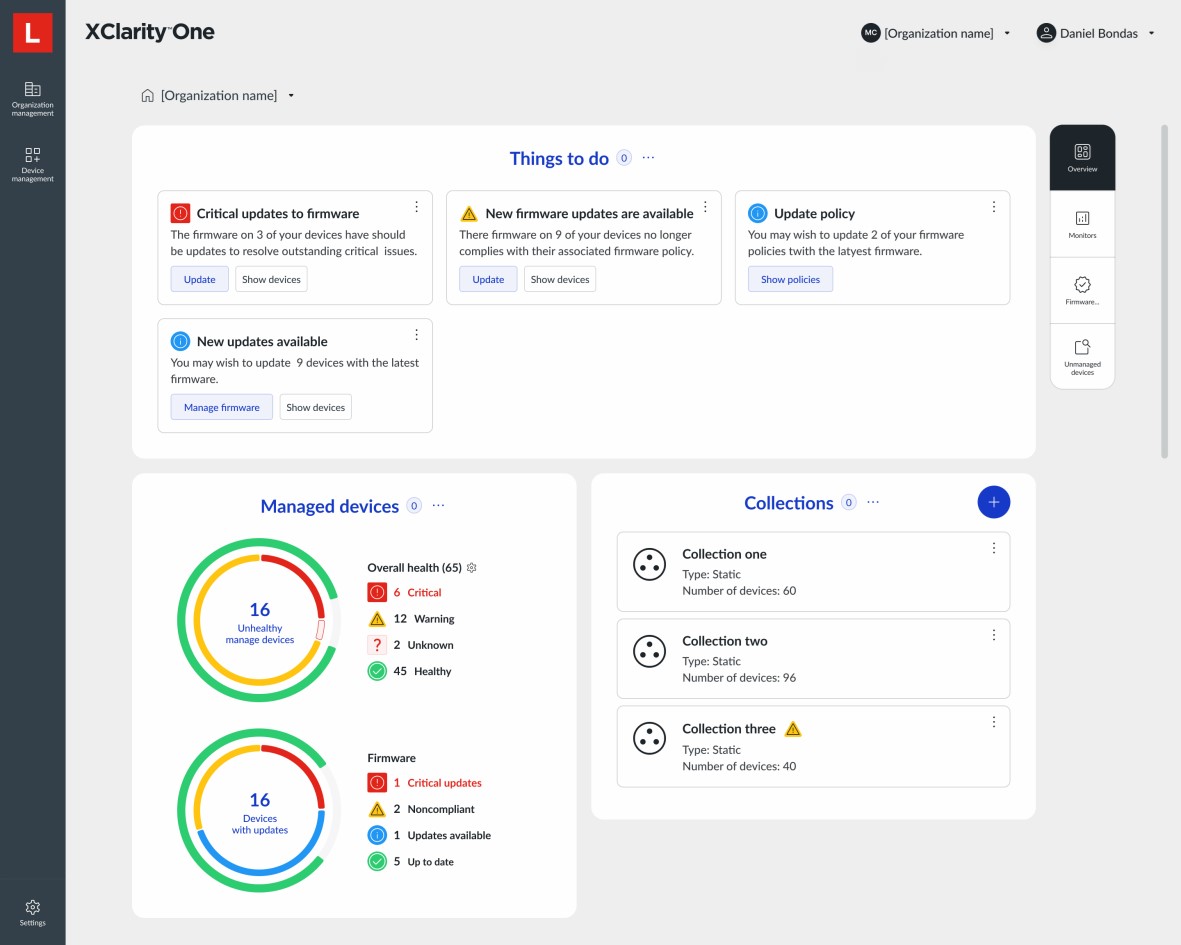
The XClarity One Portal Organization Management dashboard is the starting place after signing in to the XClarity One Portal. An example of the XClarity One Portal Dashboard is shown below.
XClarity One Portal also provides accessibility capability. You can navigate through interactive elements in the web interface by using standard keyboard keys. For more information on which keys to use see: https://pubs.lenovo.com/lxc1/portalexplore-accessibility
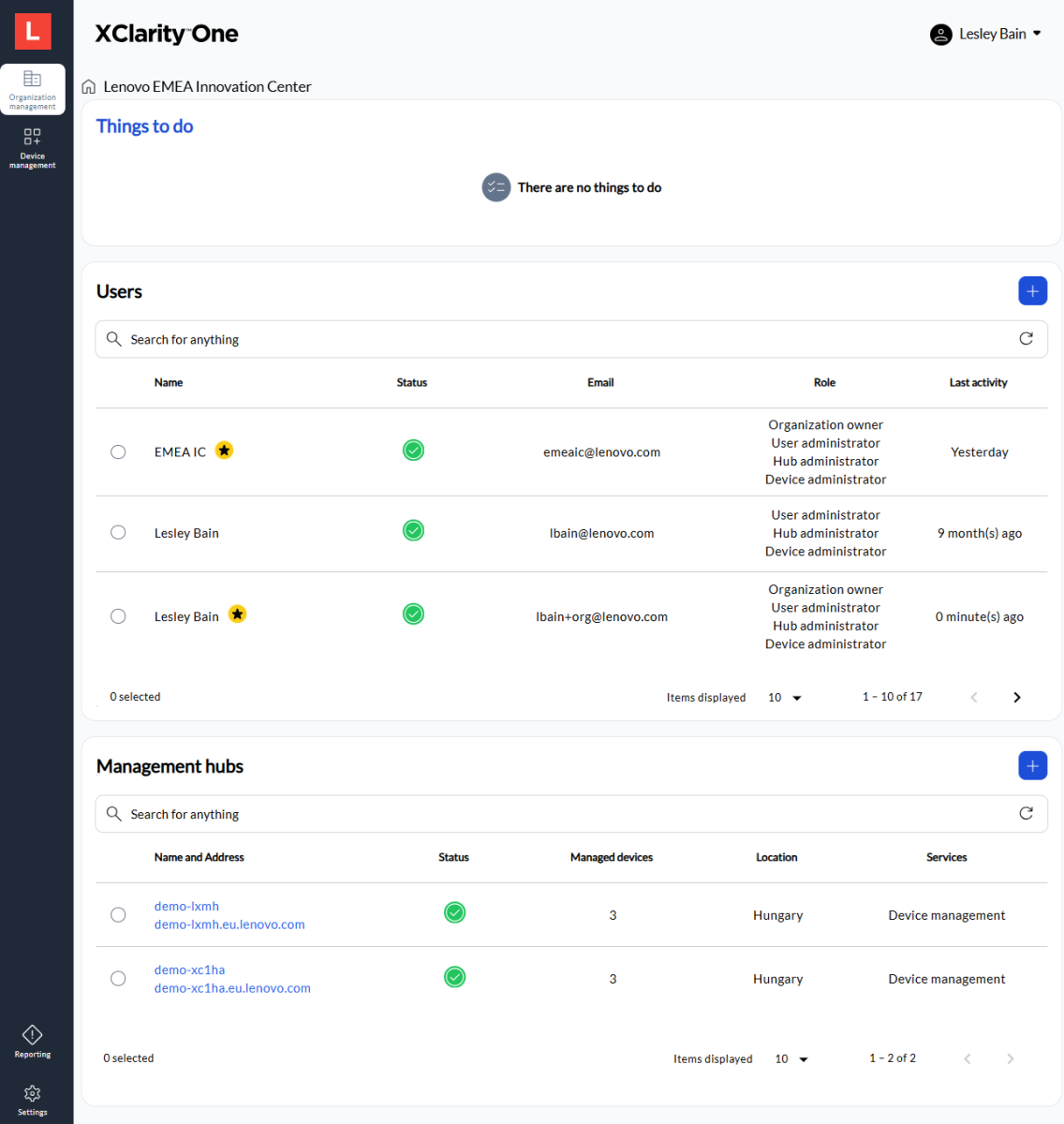
Figure 3. Lenovo XClarity One Organization Management view
Organization Management includes the following areas:
- Things to do – these will be specific tasks appropriate for the Logged in user of the Organization.
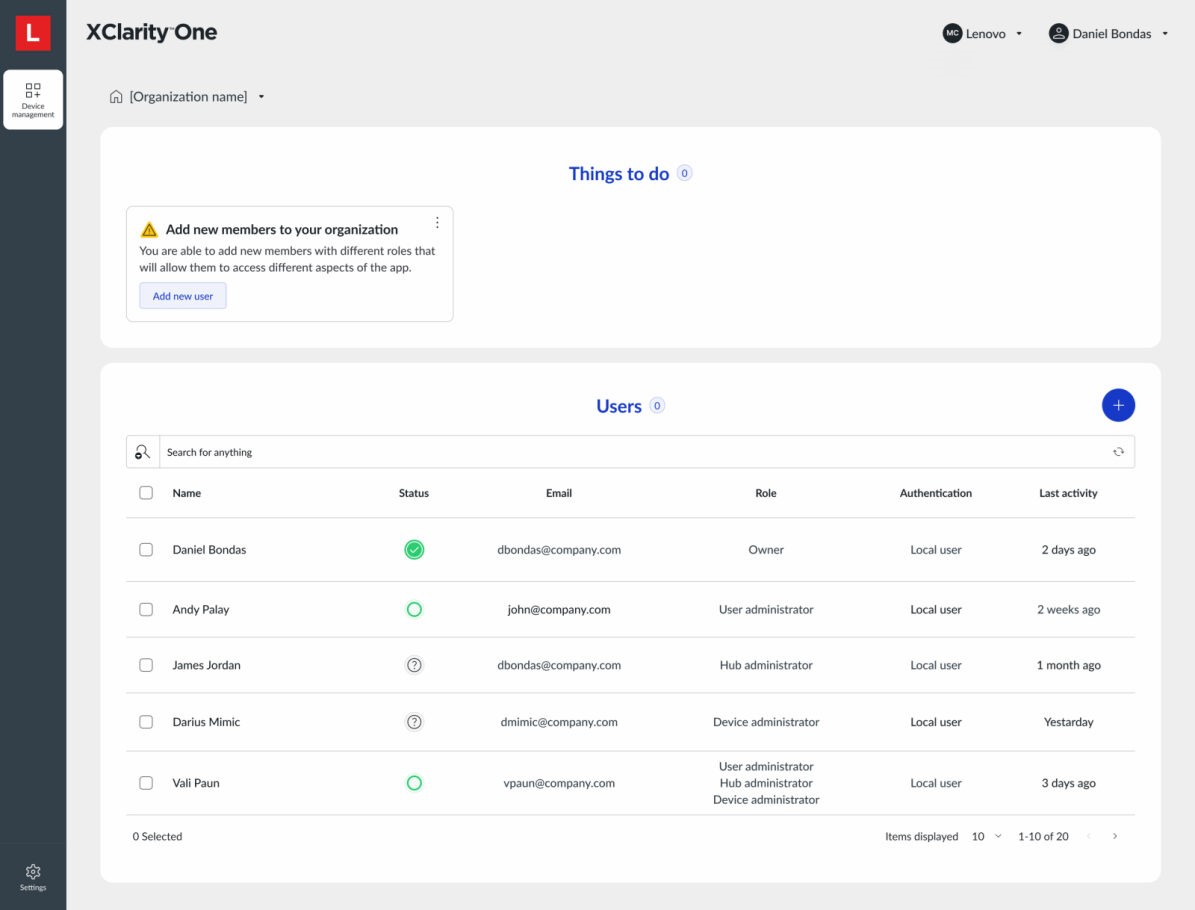
- Users – Showing the authorized users which can log in to the organization, this will provide the name, Status, Email Address Role in the organization, and last activity, you can also add additional local Users if required. See further information in User Management Section below
- XClarity One Hubs – these are the XClarity One hubs which the XClarity One Portal is communicating with which in turn manages the devices in the organization.
For more information on Exploring the XClarity One portal See: https://pubs.lenovo.com/lxc1/portalexplore within the XClarity One Documentation.
User Management
Lenovo XClarity One provides a centralized authentication server to create and manage all user accounts and to manage and authenticate user credentials. The authentication server is created automatically when the management server first starts. The User accounts, which are used to log on and manage XClarity One, can also be used for all chassis and servers that are managed by XClarity One. When you create a user account, you control the level of access, such as whether the account has read/write authority or read-only authority, by using role groups.
When devices are initially managed by XClarity One, a predefined set of role groups can have permission to access the devices by default. This predefined set is empty by default until it is configured. You can change the role groups that can access specific managed devices. When permission is given to certain role groups, only users that are members of those role groups can see and act on those specific devices.
By default, devices are managed using XClarity One managed authentication to log in to the devices. When managing rack servers and Lenovo chassis, you can choose to use managed authentication or local authentication to log in to the devices.
The following figure shows the XClarity One interface for security and user management.
For more information on adding additional local users see https://pubs.lenovo.com/lxc1/getstarted-cloud-users.
Device Management Dashboard
From the main XClarity One Portal view you can also navigate to Device Management Dashboard via the option in the left hand menu as shown in the figure below.
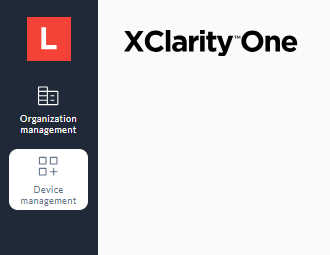
Figure 5. Menu selection for Device Management
XClarity One provides a modern, intuitive interface to manage and monitor your management hubs and managed devices XClarity one provides the following features and functions can currently be achieved:
- Discovery Of Management Hubs and devices to be managed
- Summary and detailed views of component health, asset inventory, and warranty status for your devices across multiple sites
- Dashboards that highlight items in your organization that require your attention.
- Summary and detailed views of component health, asset inventory, and warranty status for your devices across multiple sites
- Summary views of the health of your organizations, hubs, and managed devices.
- Aggregation of critical alerts and events, including Predictive failure alerts and event forwarding to external applications
- Life-cycle control for managed devices using templates (which include firmware updates and device settings configuration).
- Remote server and remote console access for management hubs and managed devices
- Usage data and trends, such as processor and memory usage, power consumption, processor temperature
- Automatic problem notification to Lenovo Support using Call Home additionally providing ability to upload service data and view Ticket status
- Viewing usage metrics and trend data
- Risk Mitigation & Resiliency
Things to do View
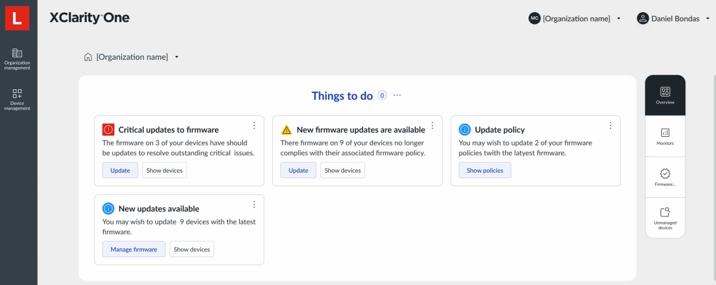
Lenovo XClarity One is a task-oriented interface that highlights items in your organization that require your attention.
Each card in the "Things to do" view has a button that takes you to a page with a list of filtered events that are related to that to-do. You can continue to drill down to figure out the actions that are needed to resolve the issue. After the issue is resolved, the to-do is deleted.
The Things to do panel lists up to six cards for the highest severity to-dos. You can also view a list of all to-dos within the context of a page or panel, including dismissed to-dos, by clicking on the Things to do title at the top of this view as shown in the figure below.
Managed Devices
The Managed Devices section on the main Organization view provides a summary for the overall health of all the devices being managed within the organization , as shown in the following figure, After the devices are managed, the XClarity One hub polls each managed device every 24 hours to collect and send inventory data to XClarity One:
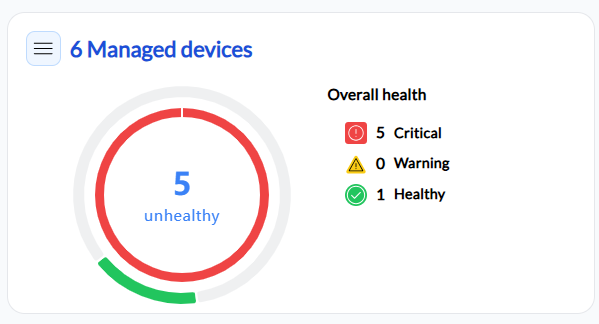
Figure 7. Overall health Summary for Managed devices
Note you can expand the overall views for the managed devices by clicking on the 3 lines to the left where you can additionally select to add Firmware and Vulnerabilities summary views, as shown in figure the following figure.
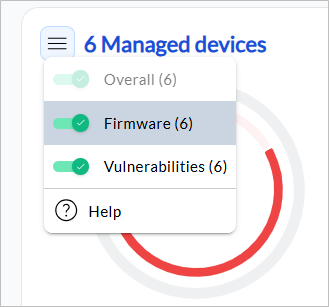
Figure 8. Ability to select other summary views
This will then provide three overall summaries views for Health, Firmware and Vulnerabilities of these three areas of management for your managed devices as shown in the following figure:

Figure 9. Example of view showing multiple Summary information additionally for Firmware and Vulnerabilities
For more information on Device Summaries see https://pubs.lenovo.com/lxc1/devices-summaries.
Collections
A collection is a static group of devices that can be grouped and monitored. A device can belong to one or more collections. Each collection can have up to 400 devices.
You can add collections to the organization and monitor the overall health of all devices in each collection. The Collection will highlight the highest severity of the current Health Status for all the systems within the collection. You can click the collection card title to list all devices in the collection and add or remove devices from the collection.
The figure below shows an example of the collections view.
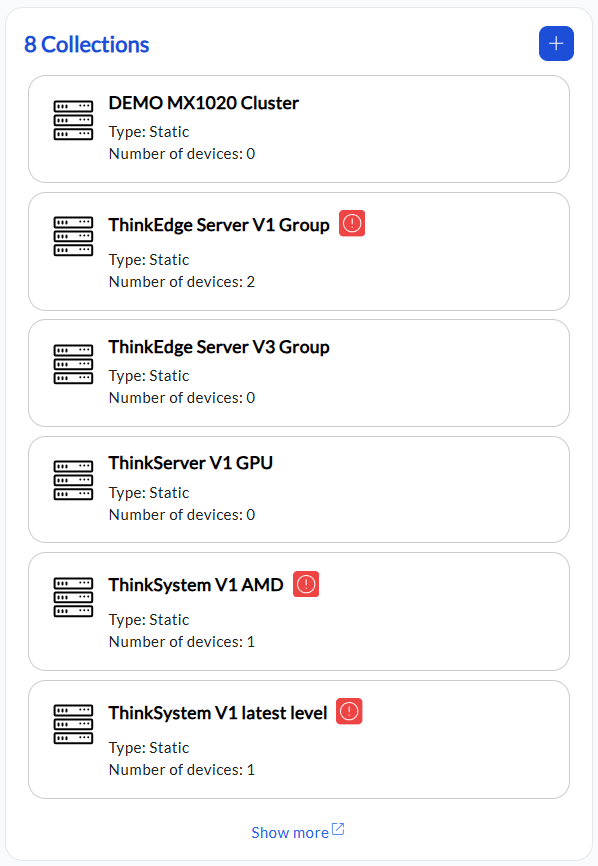
Figure 10. Collections view on Managed Device Dashboard
For more information on using Collections see https://pubs.lenovo.com/lxc1/devices-collections
Management tasks
Lenovo XClarity One Portal, provides users with the ability to perform the following tasks:
Discovering devices
XClarity One can manage the devices that are discovered by XClarity One Hub. Fast time to value is realized through automatic discovery of existing or new Lenovo Servers. However, devices can be discovered in the following ways:
- Automatically discover devices
The XClarity One Hubs automatically discover supported devices in your environment every five minutes by probing for manageable devices that are in the same IP subnet as the management hub using the SSDP protocol.
- Using a DNS Service to discover Devices
You can use a DNS service to discover ThinkSystem and ThinkEdge servers by manually adding a service record (SRV record) to your domain name server (DNS), and then enabling DNS discovery on the Lenovo XClarity Controller
- Manually Discover devices
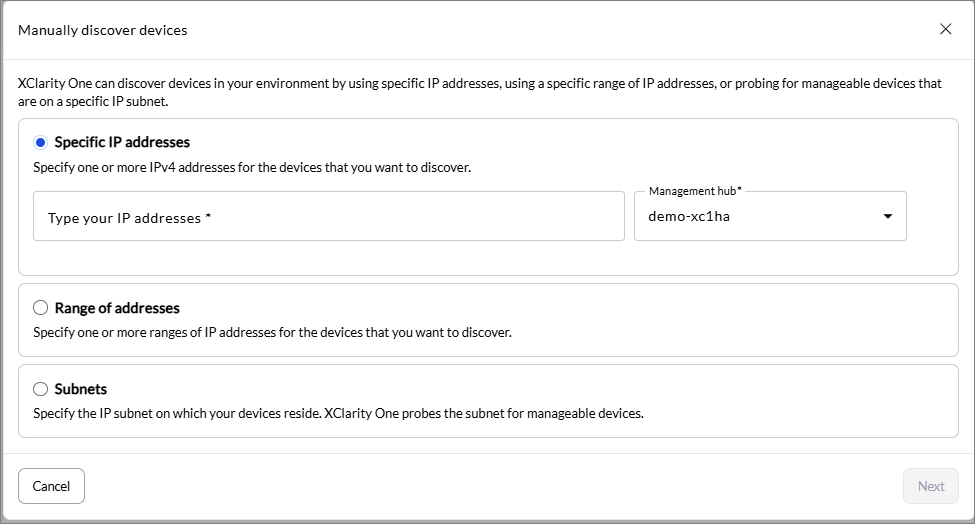
You can manually discover supported devices in other subnets using specific IPv4 addresses, full-qualified domain names, range of IP addresses, or by probing for manageable devices on specific IP subnets.From the Dashboard view you scroll down to Management Hubs, Click on the Name for the XClarity One Hub which is connected to the devices you want to discover, locate the Unmanaged devices section (you will require to scroll down the web page to locate this) Click the Add (+) Icon , and you will be presented with the Manually Discover Devices window as shown below in figure 11, Follow the steps in the wizard to identify the devices that you want to discover and the XClarity One hub that you want to use for the discovery.
After you have discovered the devices, next you need to manage them, The discovered devices are listed on the Unmanaged Devices panel in the XClarity One portal. To manage discovered devices, select the target devices, click the manage Device icon and select Manage Devices as shown in the following figure.
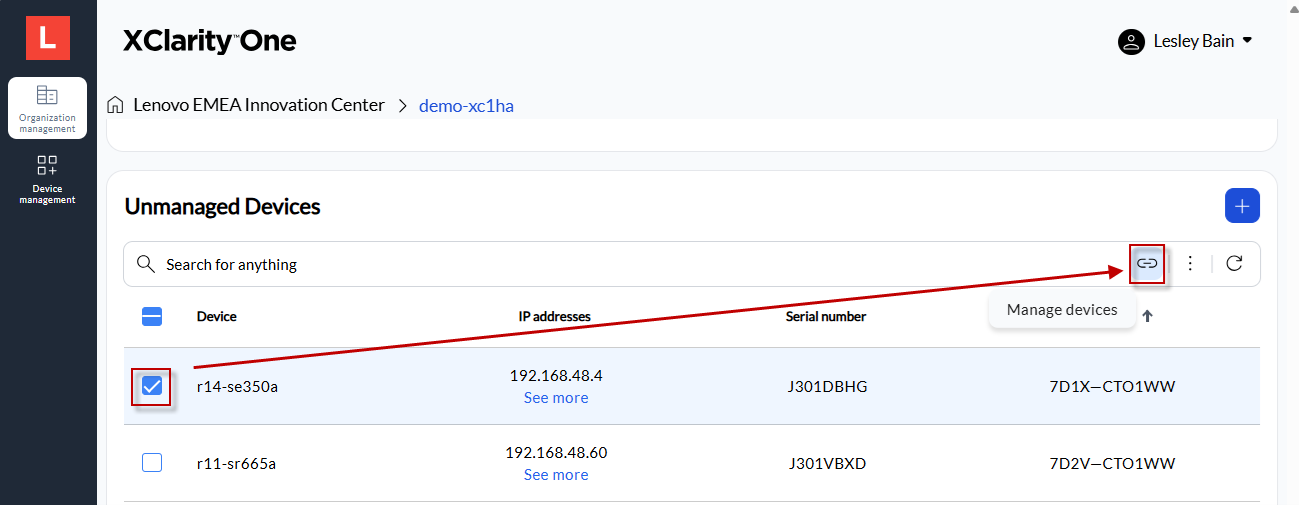
Figure 12. Selecting devices to manage
Follow the steps in the wizard to manage your device.
Provide the appropriate credentials for the device as shown in the following figure. For supported servers this is the XClarity Controller Credentials.
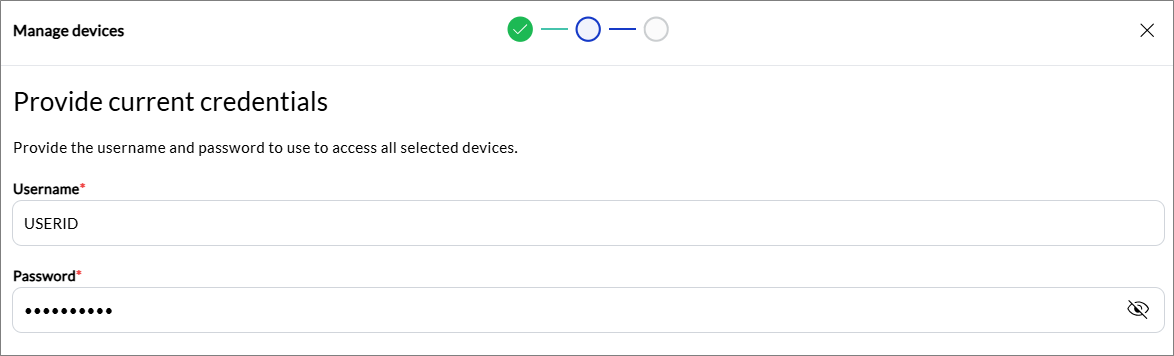
Figure 13. Provide credentials for the device to be managed
You have the option to provide credentials that you want to change on the devices which require new credentials as shown in the following figure.
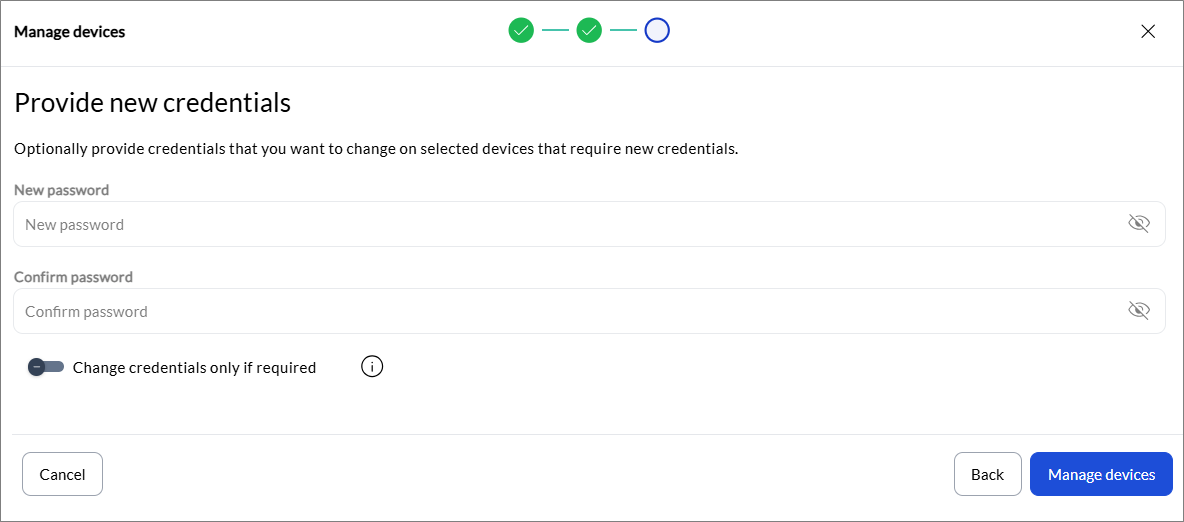
Figure 14. Providing new credentials for a device
If a device is discovered by more than one XClarity One Hub, the device is listed on the Unmanaged Devices page for each XClarity One hub that discovered it, ordered based on the discovery timestamp. When managing a device, you can choose the device that was discovered by the XClarity One Hub you want to use for management. A device can be managed by XClarity One through only one XClarity One Hub.
During the management process, the portal:
- Creates a management user account named XC1_MGR_<last 8 chars of hub UUID> with an encrypted password on the baseboard management controller for the device. The password is rotated automatically on a regular basis.
After the management process is complete, the XClarity One Hub uses this XC1_MGR_* user account to connect to the device for management purposes. The credentials that you provided during the management process are no longer used by the management hub.
- Adds subscriptions to the device for sending event and metric data to the XClarity One Hub.
- Collects inventory and vital product data.
- Collects metric data, including memory predictive failure analysis (MPFA).
- Saves sensitive information in the vault.
- Regenerates the HTTPS certificate on the server if the current HTTPS certificate is either self-signed or signed by another XClarity One Hub. The HTTPS certificate is valid for 90 days. The XClarity One Hub regenerates the HTTPS certificate on the server again 45 days before it expires. If the HTTPS certificate is signed by a third party, the XClarity One Hub sends an event and alert to XClarity One seven days before the expiration date.
For more information on Device discovery and management see: https://pubs.lenovo.com/lxc1/devices-management
Inventory of managed devices
After the devices are managed, the XClarity One Hub polls each managed device every 24 hours to collect and send inventory data to XClarity One Inventory for a device is located by clicking the Managed devices panel title from the Device management view as shown in the following figure:
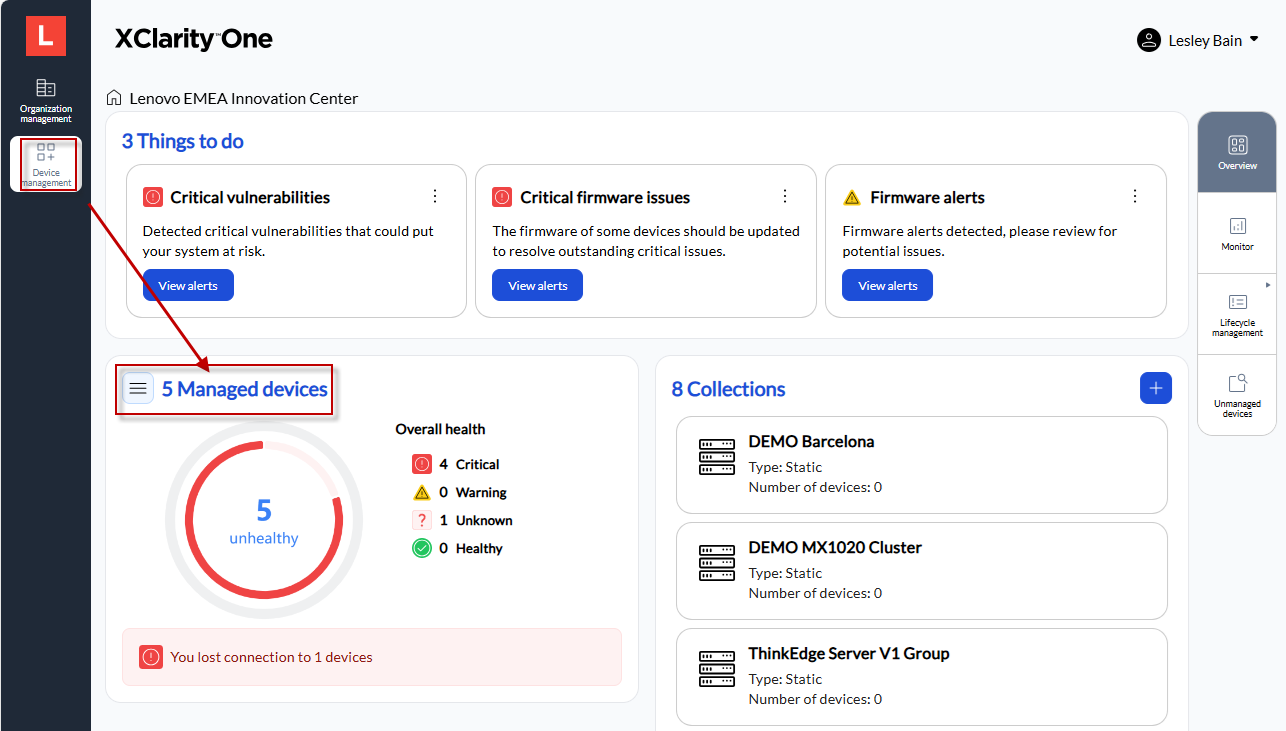
Figure 15. Location to select managed devices for drilling down deeper into a specific managed device
From the Managed devices view, click the name of the device in the table to display the device details page as shown in the following figure.
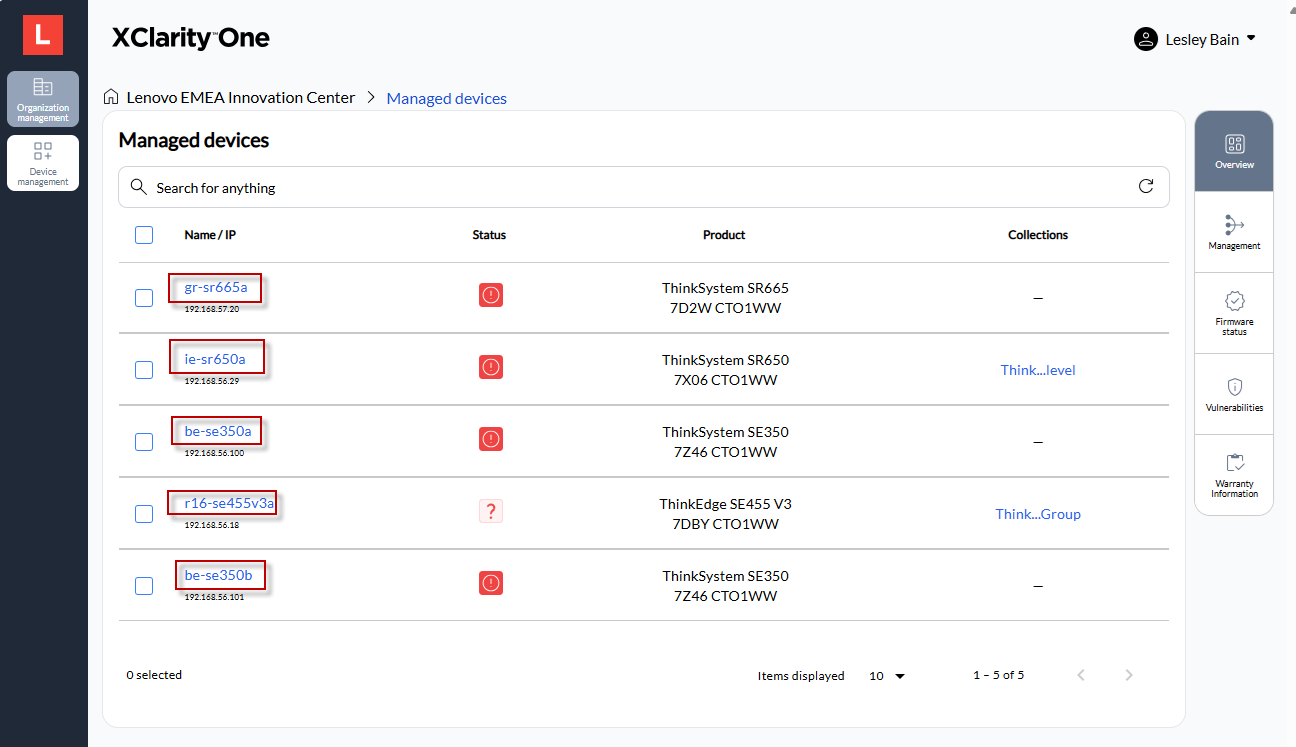
Figure 16. Link to select a specific managed device from the summary of managed devices
From the specific device page, you can then select Hardware inventory from the right-hand Menu as shown in the following figure.
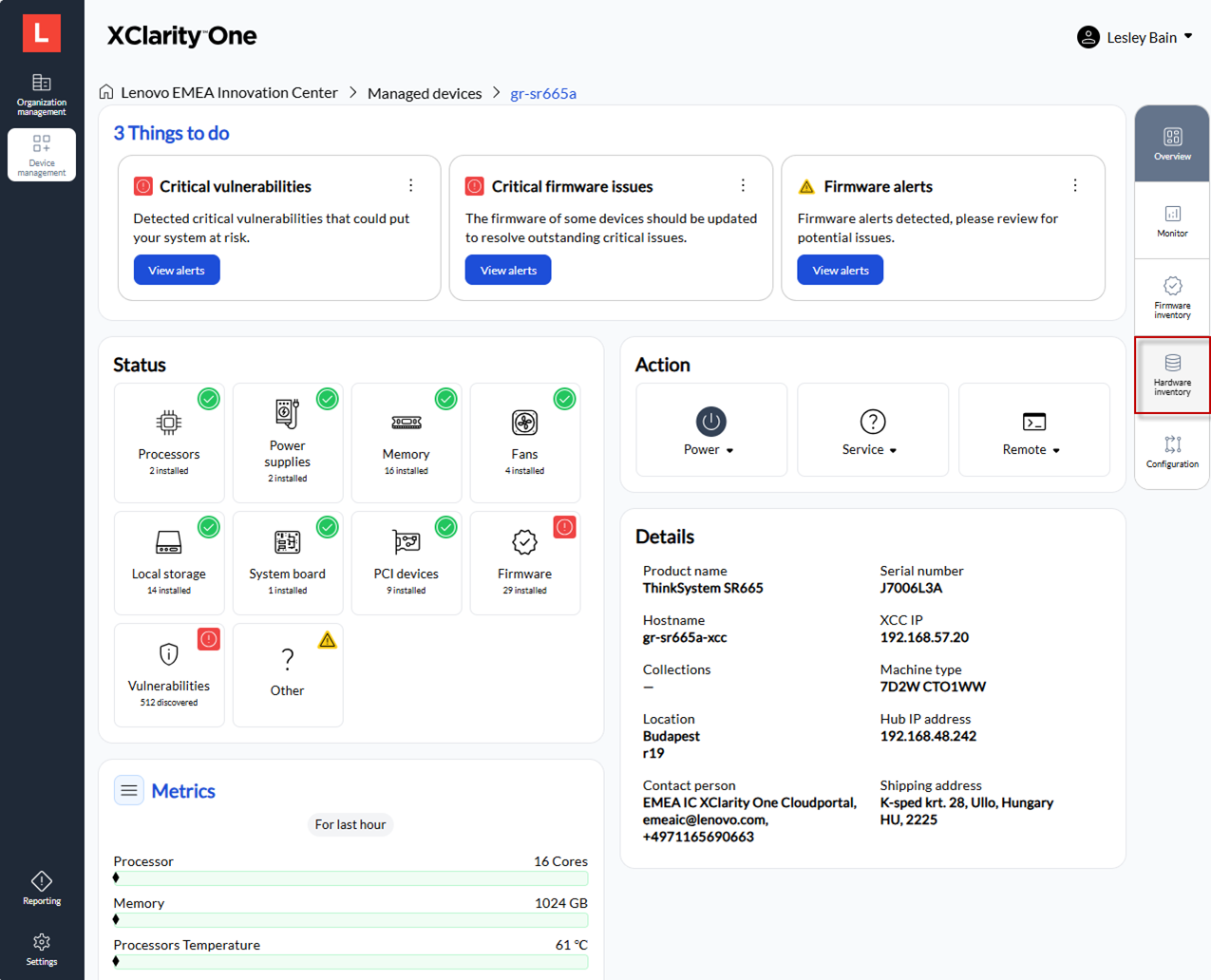
Figure 17. Specific Device page showing summary and location of Hardware inventory selection
Device specific summary view
You will be presented the full inventory as shown in the figure below, for the managed device, you can scroll up and down to view the various components within the managed device, Note there may be components that have a + See Details which if expanded will provide additional information on that specific component as shown in the picture below, you can Expand or collapse the information as required.
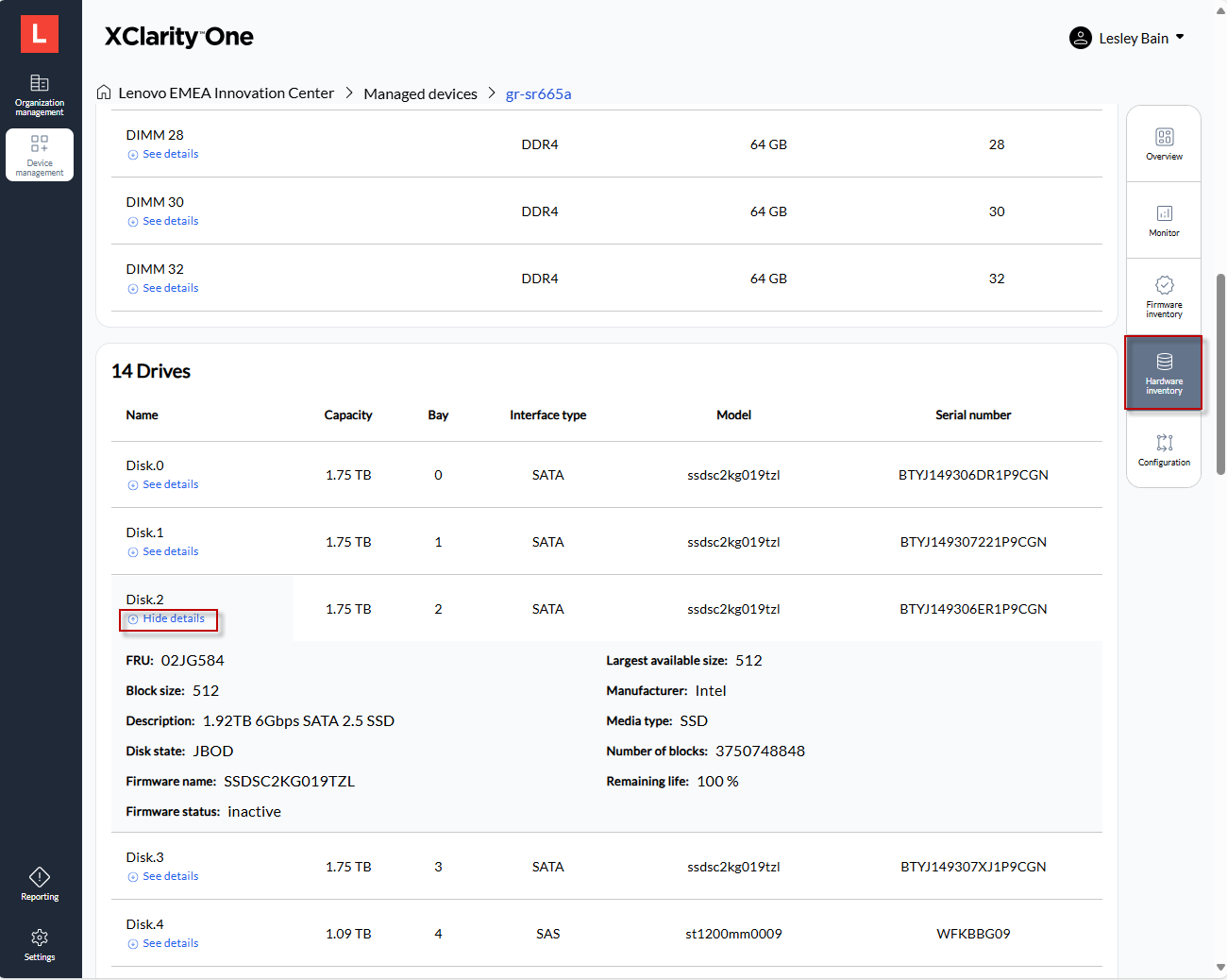
Figure 18. Inventory view for a specific device
Managed Device view
Additionally, within the Managed Device view for a specific managed device there will also be the following sections:
- Things to do – Providing device specific to-dos per logged in user.
- Status panel - showing the status health of each component in the device.
- Hardware components. Based on the highest severity of all events that are associated with each component, such as processors, memory, fans, and PCI devices. For more information on Health Summaries see https://pubs.lenovo.com/lxc1/devices-summaries
- Based on age and number of vulnerabilities.
- Based on whether the component firmware has warning or critical vulnerabilities. For more details on Vulnerabilities see https://pubs.lenovo.com/lxc1/devices-fw-vulnerabilities
- Based on the highest severity of all events of other categories, such as warranty. For more information on warranties see https://pubs.lenovo.com/lxc1/devices-warranties
- Action – which encompasses the Power options as detailed https://pubs.lenovo.com/lxc1/devices-powerops
- Details – Providing detailed information about a specific device. For more information on Device details see https://pubs.lenovo.com/lxc1/devices-details
- Metrics - Providing detailed usage metrics for a specific device. For more information on Metrics see https://pubs.lenovo.com/lxc1/devices-usage
See figure below showing each section described.
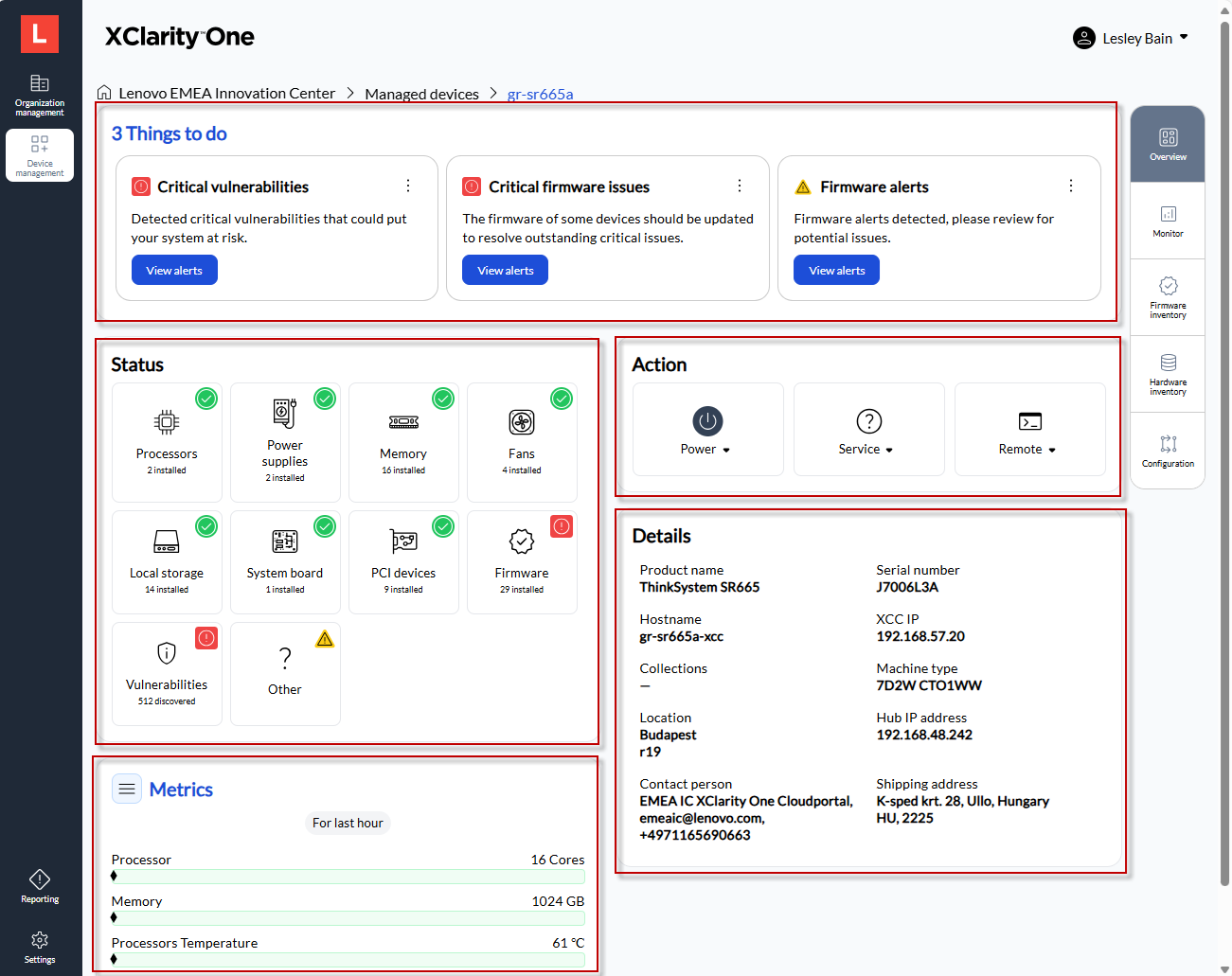
Hardware monitoring
Lenovo XClarity One provides a centralized view of events and alerts that are generated from managed endpoints.
When an issue is detected, an event is passed to XClarity One. That event is then displayed in the alerts list that is available within the user interface. A status bar also is available that provides overall status information on the main XClarity One interface.
An example list of alerts is shown in the following figure. This view can be filtered to show specific alert severity. Additionally, the view can also be filtered by dates and alert sources or via the search filter.
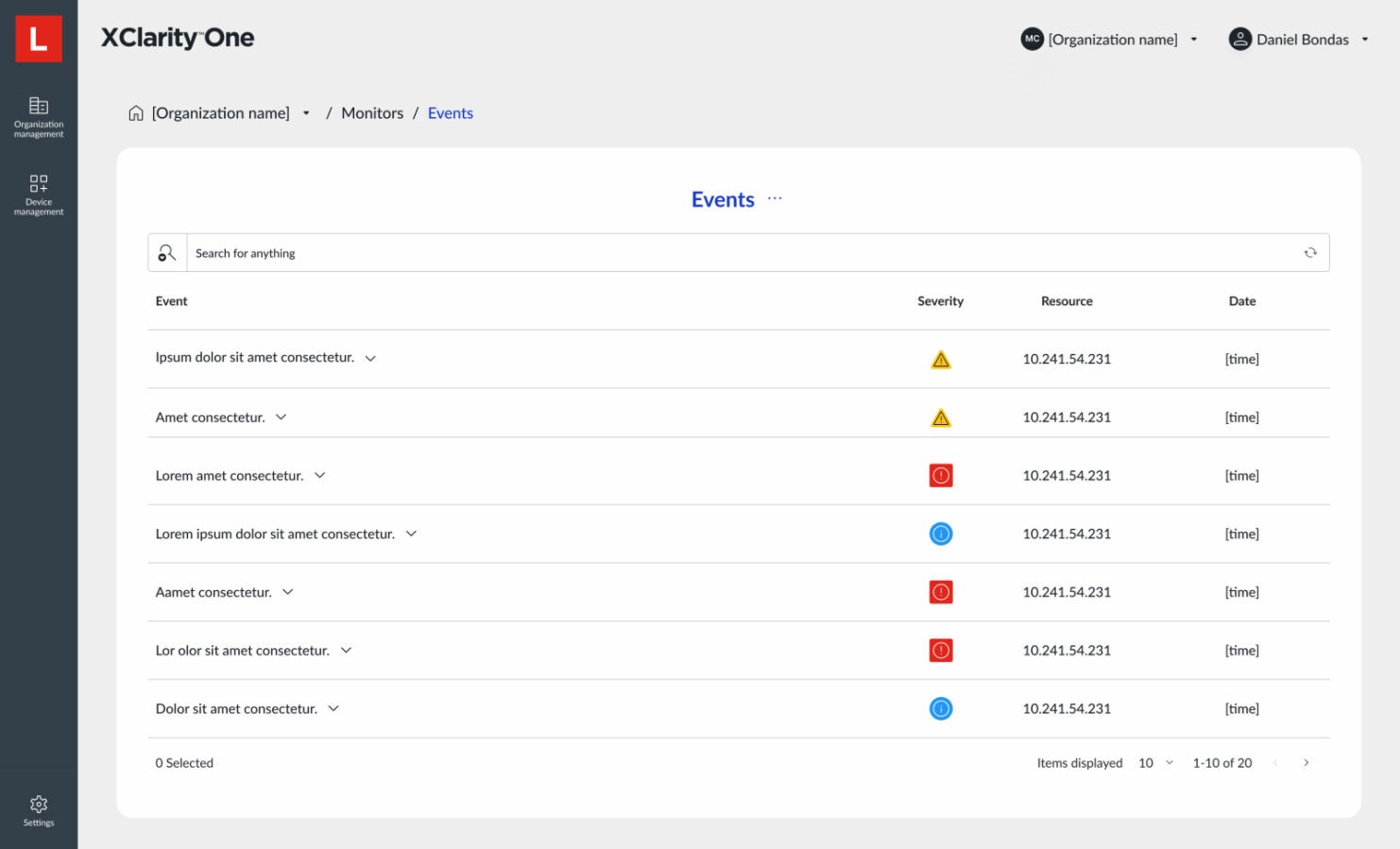
For More information on Device Health summaries, see https://pubs.lenovo.com/lxc1/devices-summaries
Firmware updates
For XClarity One in the Cloud, Lenovo ensures that the latest firmware versions are available. However, there might be cases where limited availability fixes (LAFixes) might be created by Lenovo specifically for you and need to be manually imported into the cloud portal for your organization.
For XClarity One as a local virtual machine, you need to manually download update packages from the Lenovo Data Center Support website and then import them into XClarity One.
For more information on firmware packages see https://pubs.lenovo.com/lxc1/devices-fw-packages
The Things To Do panel displays a card when new firmware updates are available. From the todo, you can view the alerts for each new firmware update.
You can install firmware updates on one or more devices using templates Seeeample view below in figure 21. For more information, see https://pubs.lenovo.com/lxc1/devices-templates.
Lenovo XClarity One uses the XClarity One hubs to apply firmware updates to your managed devices. When you initiate a firmware update from the XClarity One portal, XClarity One pushes the required update packages to the appropriate XClarity One Hub and then sends a request to the hub to apply the update on the target devices. The XClarity One Hub sends status, progress, and log data back to the XClarity One portal during the update process so you can monitor progress.
For more information on Firmware updates see the online documentation: https://pubs.lenovo.com/lxc1/devices-fw
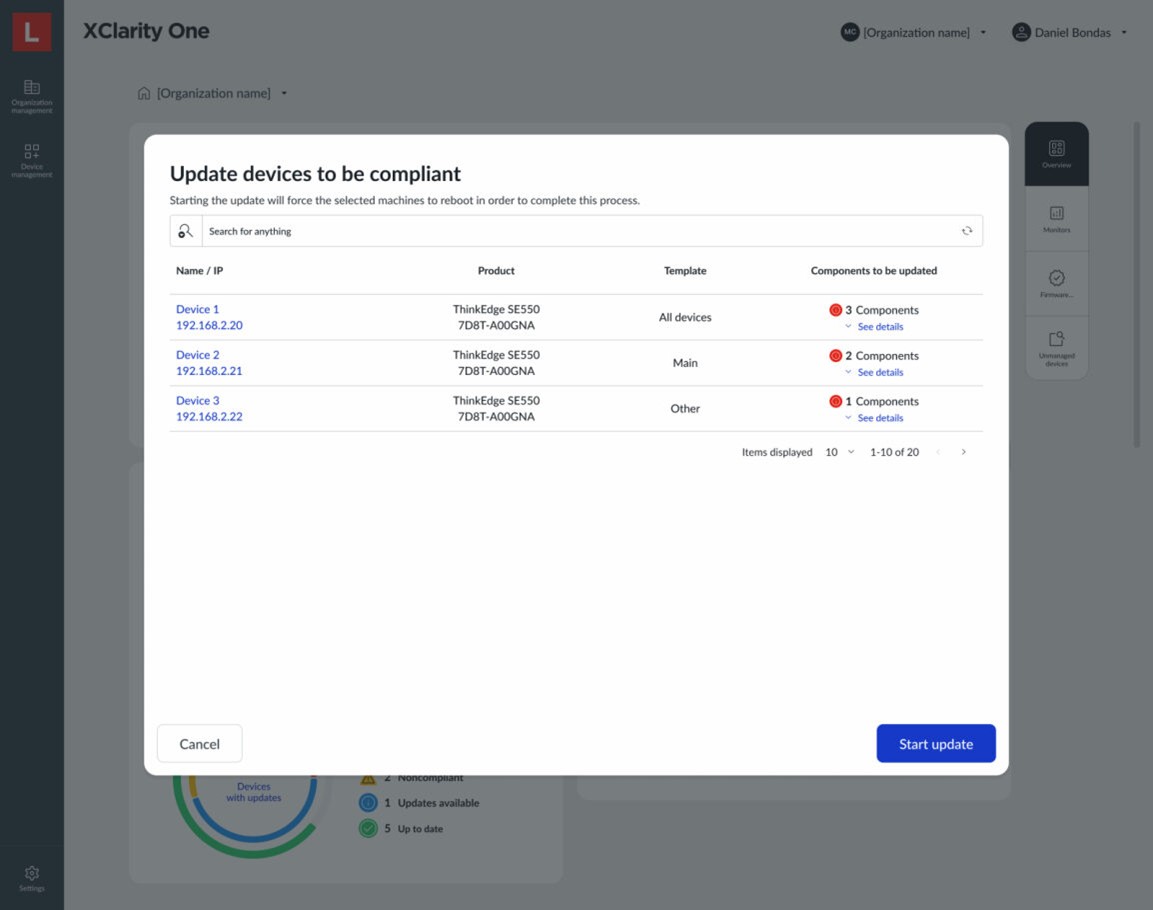
Device settings
You can use Lenovo XClarity One to quickly configure and maintain device settings on your managed devices by learning the device-settings configuration from an existing device and then applying that configuration to your other servers. You can then use the health summaries to identify the device-settings health of your devices, use templates to identify the target settings-configuration that you want to maintain on each device, and update target devices to match the target configuration. Currently you can use device-settings configurations to configure system information, boot order, baseboard management controller, and Unified Extensible Firmware Interface (UEFI) settings on managed servers.
XClarity One creates a device-settings configuration by learning the settings on a golden master device that has the correct firmware level and device settings that you want to apply on target devices.
You can create device Setting templates by selecting Device management view from the menu on the left, Then Lifecycle Management on the context menu on the right , then click Device settings from the context menu on the right, as shown in the following figure.
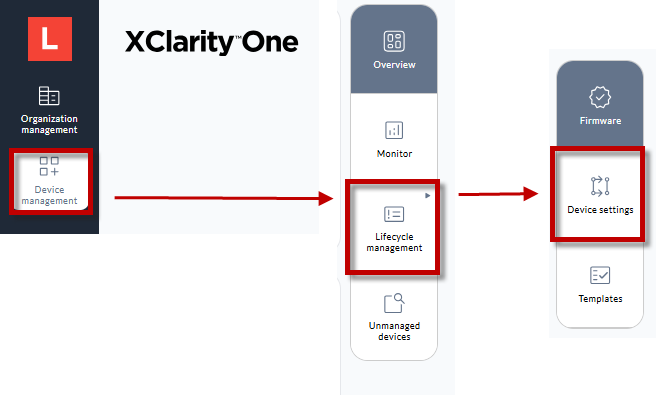
Figure 22. Menu selections for Device settings
Once within the Device Settings view you can then select to create a Device Setting template by clicking on the Add button.as shown in the following figure.

Figure 23. Selection view to initiate creating a device settings template
You should provide an appropriate name and description for the device settings and click Next to continue
You are then asked to select the device which has the desired settings and click Done. As shown below in the following figure:

Figure 24. Selecting a device to capture settings from
A job will then start to capture the device settings (learn)from the selected server. You can view the Job running in the Jobs view via Device Management (Left Context Menu) > Monitor (Right Context Menu) > Scroll down to the Jobs view and click See Jobs. Se example of the Job running view in the following figure.
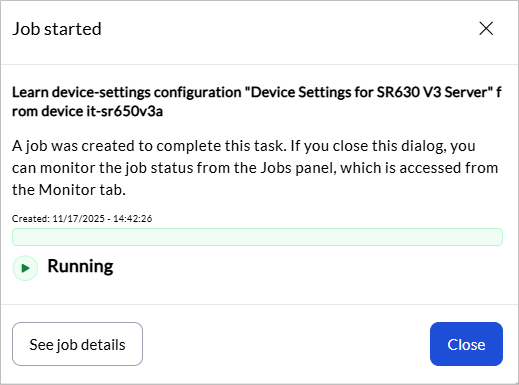
Once the Job has completed the settings template will be shown in the list of device settings, as shown in the following figure.
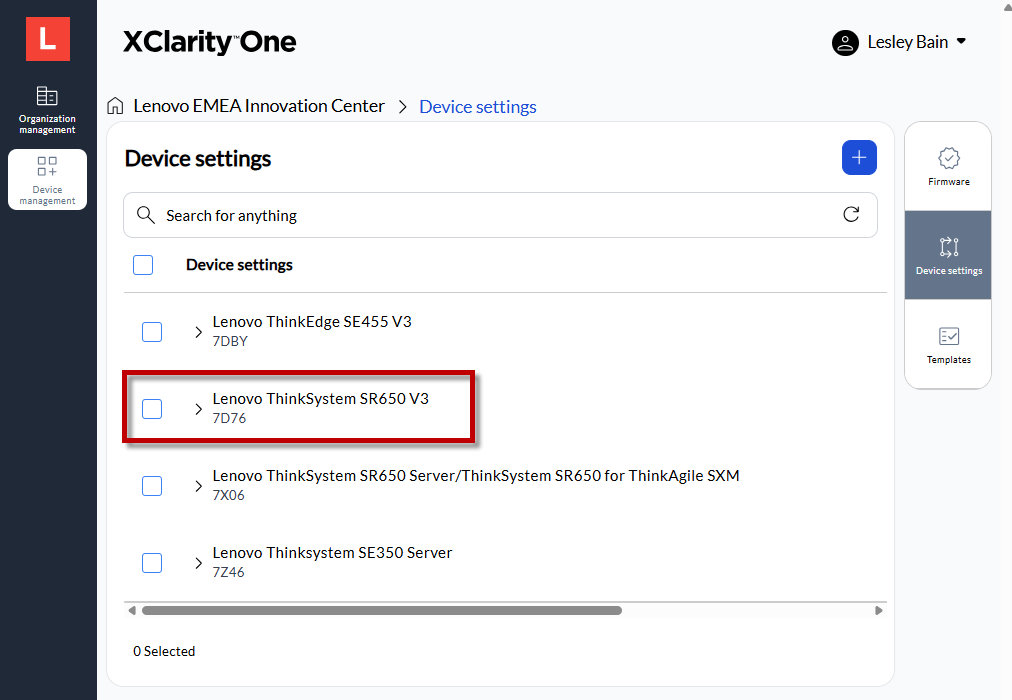
Figure 26 Settings template list
You can then assign and apply the device-settings configuration to target devices that have the same machine type and specifications (such as processors, memory, storage, and features-on-demand keys) as the golden master device.
If a device-settings configuration or template is assigned to a device, you can view the device-settings compliance. XClarity One checks the compliance status of devices by comparing the current settings on the target device with the settings that are defined by its assigned device-settings configuration.
The compliance status can be one of the following.
- Compliant. No action is required. The device complies with the assigned device settings configuration.
- Not Compliant. Target device is not compliant to the assigned device settings configuration. Apply a configuration or template to target device to make it compliant.
- Not Applicable. Target device is not applicable with the assigned device settings due to mismatched or conflict setting definitions. In this case, the assigned device-setting configuration cannot be applied to target device.
The settings on a device might not be applicable with its assigned device-settings configuration in the following instances.- Device firmware on the target device is different than the golden-master device that was used to generate the device-settings configuration.
If the target device has different firmware levels than the golden-master device, upgrade the firmware on the target devices to match the golden master device before applying the device-settings configuration
- Device has different machine type or hardware specifications (such as processors, memory, storage, and features-on-demand keys) than the with the device from which the device-settings configuration leaned.
- Device firmware on the target device is different than the golden-master device that was used to generate the device-settings configuration.
- Calculating. The compliance status is being calculated.
- Unknown. The portal failed to calculate the compliance status. Check the events logs for details.
For more information on using Device settings see https://pubs.lenovo.com/lxc1/devices-settings.
Operating System deployment
With the latest release of the XClarity One Hub version 1.5 and the XClarity One Portal v25.3 you can now use Lenovo XClarity One to deploy the operating system to bare metal devices. XClarity One does not maintain the repository of operating systems. You need to manually download and import operating-system files that you want to deploy in your organization.
For information about supported operating systems, see Supported operating-systemsat the following link https://pubs.lenovo.com/lxc1/devices-os-supported.
When you import operating-system files, the files are available only the organization that you belong to.
For all operating system image files, you must also provide a sha256sum or signature file or both.
For more information on importing operating System images, refer to https://pubs.lenovo.com/lxc1/devices-os-repo.
When you create a template that includes an operating system, you can configure the operation-system settings (such as host naming conventions, networking, and storage) to use during deployment.
For further information on the operating System settings required, see https://pubs.lenovo.com/lxc1/devices-os-settings.
Lenovo XClarity One Portal uses the XClarity One hubs to deploy an operating system to your bare-metal servers. When you initiate an operating system deployment from the XClarity One portal, XClarity One Portal pushes the required operating-system image to the appropriate XClarity One hub managing that particular server and then sends a request to the XClarity One hub to apply the operating system on the target devices. The XClarity One Hub sends status, progress, and log data back to the XClarity One portal during the deployment process so you can monitor progress.
You can install operating-systems on one or more devices using templates. For more information, see Device templates at the following link: https://pubs.lenovo.com/lxc1/devices-templates
Device templates
Lenovo XClarity One makes it easy to quickly setup and maintain your devices by deploying firmware, device settings, and operating systems on your managed devices using templates. Device templates consist of a set of rules and criteria that define the desired configuration for a certain type of device and identifies which managed devices are monitored for compliance. If a device is out of compliance, their health status changes to Critical. You can use the templates to update the device to match the desired profile.
The following figure shows an example of the Templates view.
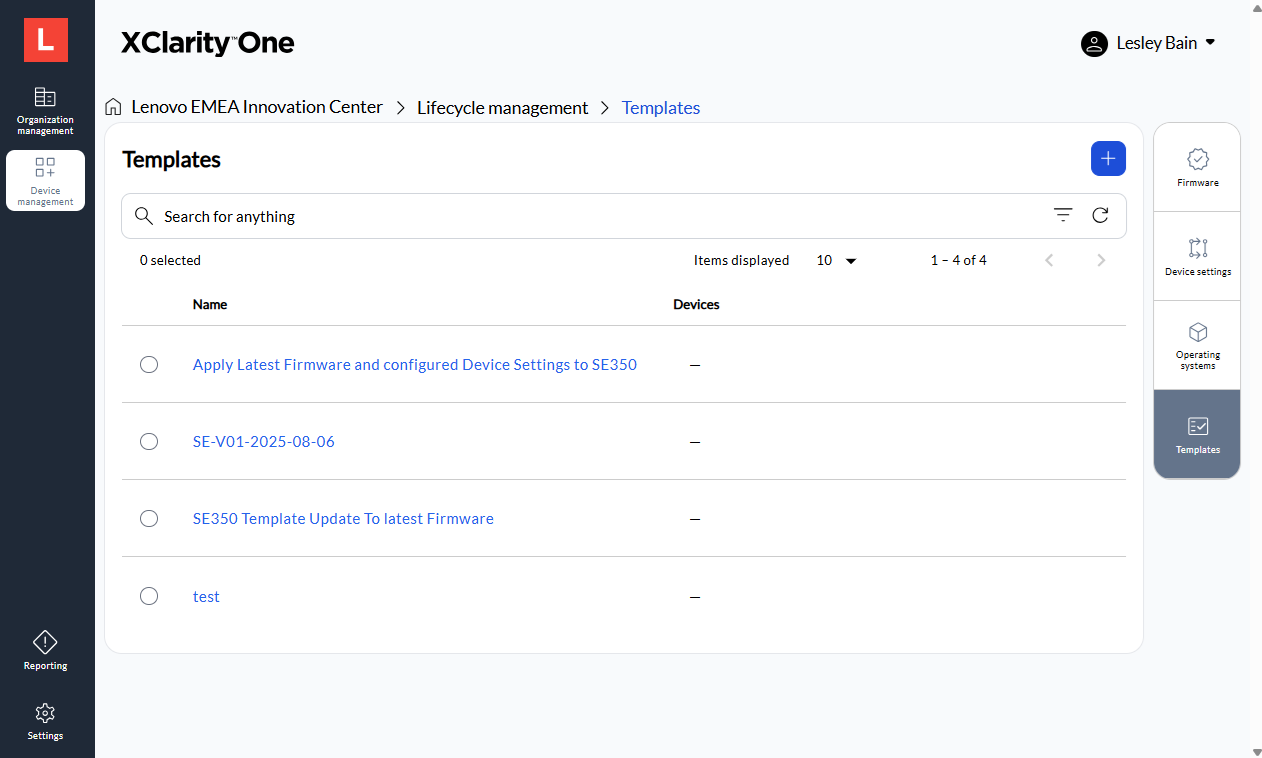
For more information on creating device templates, see https://pubs.lenovo.com/lxc1/devices-templates
Service and support
Lenovo XClarity One provides a set of tools that you can use to collect and send service-data files to Lenovo Support, set up automatic notification to Lenovo Support when serviceable events occur on specific devices, monitor service-tickets, and view warranty information. You can contact Lenovo Support to get help and technical assistance when you run into problems.
Customers have the following options for Service and Support:
- Automatic problem notification (Call Home)
Call Home can be used to automatically notify Lenovo Support when a serviceable event occurs on a specific device that is under warranty and to ship replacement parts if needed.
Note: Lenovo is committed to security. When service data is sent to Lenovo Support either automatically through Call Home or manually by you, the service-data archive is sent to Lenovo Upload Facility over HTTPS using TLS 1.2 or later. Your business data is never transmitted. Access to service data in the Lenovo Upload Facility is restricted to authorized service personnel.
Customers must agree to the Call Home agreement (privacy statement) to use Call Home, to manually upload files to Lenovo Support, and to attach notes and files to a service ticket. If you disable the Call Home agreement, those functions are also disabled.
For more information on configuring Automatic Problem Notification (Call home) refer to https://pubs.lenovo.com/lxc1/support-callhome.
- Call Home contacts
When you set up Call Home, you provide the names and contact information for people that Lenovo Support can contact when an automatic service ticket is opened for a serviceable event that is generated by one of the managed devices. You must provide a primary contact and can optionally provide a secondary contact.
You can also assign a contact to all devices in a specific collection. If a device does not have an assigned contact, the primary contact that is provided for Call Home is used.
Note: You must test the connect to Call Home before you can apply the Call Home contact information and enable
- Service tickets
Opening a service ticket starts the process of determining a resolution to your device issues by making the pertinent information available to Lenovo Support quickly and efficiently. Lenovo service technicians can start working on your resolution as soon as a service ticket is opened. Refer to https://pubs.lenovo.com/lxc1/support-servicetickets for more information on Service Tickets
- Technical assistance
If you run into problems you can refer to the section in the documentation on Troubleshooting and resolving problems and need technical assistance with Lenovo XClarity One, you can contact XClarity One support using the Contact Us webpage.
Seller Training Courses
The following sales training courses are offered for employees and partners (login required). Courses are listed in date order.
-
VTT: LOC-A is not going away, LOC-A is evolving - October 2025
2025-10-24 | 27 minutes | Employees Only
DetailsVTT: LOC-A is not going away, LOC-A is evolving - October 2025
Join this session to gain a comprehensive understanding of Lenovo Open Cloud Automation (LOCA) — where it stands today, the latest innovations, and the exciting roadmap ahead.
Published: 2025-10-24
We’ll walk you through the current capabilities, share recent developments, and give you a glimpse into the direction LOC-A is heading.
Tags: Cloud, Technology solutions, XClarity
Length: 27 minutes
Course code: DVSYS220Start the training:
Employee link: Grow@Lenovo
-
Discover XCC3 & What’s New in XClarity One
2025-10-07 | 68 minutes | Employees Only
DetailsDiscover XCC3 & What’s New in XClarity One
Please join this session as our speakers explore the latest advancements in Lenovo infrastructure management, including a deep dive into XCC3 and an exclusive look at what's new in XClarity One. Discover how these technologies are shaping the future of intelligent infrastructure.
Published: 2025-10-07
Tags: Technology solutions, XClarity
Length: 68 minutes
Course code: DVSYS219Start the training:
Employee link: Grow@Lenovo
-
Partner Technical Webinar - XClarity One
2025-09-15 | 60 minutes | Employees and Partners
DetailsPartner Technical Webinar - XClarity One
In this 60-minute replay, Chuck Weber, Lenovo Sr Product Manager, reviewed the future of IT Operations tool: XClarity One. Chuck reviewed the features and roadmap for XClarity One. He concluded with a live demo.
Published: 2025-09-15
Tags: XClarity
Length: 60 minutes
Course code: SEP1225Start the training:
Employee link: Grow@Lenovo
Partner link: Lenovo 360 Learning Center
-
VTT: XClarity One Update and Roadmap - July 2025
2025-07-16 | 50 minutes | Employees Only
DetailsVTT: XClarity One Update and Roadmap - July 2025
Join WW PM Geoff Hunt and friends to review the latest release for XClarity One and to explore what else to expect in the next 6 months.
Published: 2025-07-16
Topics will include On-Premise deployment, an update on Nutanix SAM (previous VTT topic), enhancement to templates, Northbound APIs and more!
Tags: Technology solutions, XClarity
Length: 50 minutes
Course code: DVSYS218Start the training:
Employee link: Grow@Lenovo
-
Understanding Lenovo XClarity
2025-06-11 | 8 minutes | Employees and Partners
DetailsUnderstanding Lenovo XClarity
This course is designed to give Lenovo sales and partner representatives an understanding of Lenovo XClarity.
Published: 2025-06-11
Learning Objectives:
•Identify the different components of XClarity
•Describe the primary benefits to customers
•Define its core features
Tags: XClarity
Length: 8 minutes
Course code: SXXW2118r2Start the training:
Employee link: Grow@Lenovo
Partner link: Lenovo 360 Learning Center
-
VTT: Nutanix Integration in XClarity One - SAM - May 2025
2025-06-10 | 56 minutes | Employees Only
DetailsVTT: Nutanix Integration in XClarity One - SAM - May 2025
Please join this session as our speaker Sorin Tacu, will be sharing us a preview of SAM (Solutions Advanced Manager) - a powerful new tool developed by the ThinkAgile HX team in collaboration with XClarity One. Designed to seamlessly integrate the Nutanix Solution into XClarity One, SAM is set to streamline solution management and drive greater value for our customers. Get a first look at its future capabilities and learn more about it.
Published: 2025-06-10
Tags: Nutanix, XClarity
Length: 56 minutes
Course code: DVSYS217Start the training:
Employee link: Grow@Lenovo
-
VTT: XClarity One Update overview & Direction - April 2025
2025-04-11 | 58 minutes | Employees Only
DetailsVTT: XClarity One Update overview & Direction - April 2025
Please join our special guests for this first of three sessions series to find out more about Lenovo XClarity One, what are the most recent updates, and what is the direction regarding the on-prem version of XC1.
Published: 2025-04-11
Tags: Technology solutions, XClarity
Length: 58 minutes
Course code: DVSYS216Start the training:
Employee link: Grow@Lenovo
-
VTT: XClarity One New Features and Roadmap - January 2025
2025-01-22 | 80 minutes | Employees Only
DetailsVTT: XClarity One New Features and Roadmap - January 2025
Please join this session as our speaker, Eric Pitcher, will be sharing an updated XC1 product overview and direction. He will provide insight into the product and offer invaluable insights about the new features and direction of XC1. This is a great opportunity to learn more about the main features, new content and where you can find additional information in case you require it.
Published: 2025-01-22
Tags: Server, Software Defined Infrastruture (SDI), Storage, Technology solutions, ThinkSystem, XClarity
Length: 80 minutes
Course code: DVSYS213Start the training:
Employee link: Grow@Lenovo
-
Lenovo XClarity One: Overview
2024-10-08 | 30 minutes | Employees and Partners
DetailsLenovo XClarity One: Overview
In this course you will learn about ways to initiate and conduct a conversation about Lenovo XClarity One. Lenovo XClarity One is a cloud-based, unified software management platform, that integrates TruScale Infrastructure as a Service, Management as a Service, and Smarter Support Analytics to simplify orchestration, automation, and metering from the edge to the cloud. By the end of this course, you will be able to describe the Lenovo XClarity One software, identify the main Features and Benefits of XClarity One, and discover the available XClarity One Contacts and Resources.
Published: 2024-10-08
Tags: Technology solutions, XClarity
Length: 30 minutes
Course code: DXCOO101r2Start the training:
Employee link: Grow@Lenovo
Partner link: Lenovo 360 Learning Center
-
Q2 Solutions Launch TruScale GPU Next Generation Management in the AI Era Quick Hit
2024-09-10 | 6 minutes | Employees and Partners
DetailsQ2 Solutions Launch TruScale GPU Next Generation Management in the AI Era Quick Hit
This Quick Hit focuses on Lenovo announcing additional ways to help you build, scale, and evolve your customer’s private AI faster for improved ROI with TruScale GPU as a Service, AI-driven systems management, and infrastructure transformation services.
Published: 2024-09-10
Tags: Artificial Intelligence (AI), Services, TruScale
Length: 6 minutes
Course code: SXXW2543aStart the training:
Employee link: Grow@Lenovo
Partner link: Lenovo 360 Learning Center
-
VTT: XClarity One Status - October 2023
2023-10-12 | 27 minutes | Employees Only
DetailsVTT: XClarity One Status - October 2023
XClarity One successfully launched the early preview Alpha program in August. In this session I will give an update on the status of XC1, it’s short-term roadmap and the program experiences to date. As a focus, I will also discuss the key customer feedback we have received. Please come with your questions and suggestions.
Published: 2023-10-12
Tags: XClarity
Length: 27 minutes
Course code: DVSYS205Start the training:
Employee link: Grow@Lenovo
Related links
For more information, see the following resources:
- Lenovo XClarity One product page:
https://www.lenovo.com/us/en/servers-storage/software/xclarityone/ - Lenovo XClarity One portal:
http://https://xclarityone.lenovo.com/ - Lenovo XClarity One User Guide:
http://https://pubs.lenovo.com/lxc1/ - Lenovo XClarity One Software Download page
http://https://support.lenovo.com/solutions/lnvo-xc1 - Lenovo XClarity One Management Hub 2.0 Support page:
http://https://support.lenovo.com/us/en/solutions/ht516492
Trademarks
Lenovo and the Lenovo logo are trademarks or registered trademarks of Lenovo in the United States, other countries, or both. A current list of Lenovo trademarks is available on the Web at https://www.lenovo.com/us/en/legal/copytrade/.
The following terms are trademarks of Lenovo in the United States, other countries, or both:
Lenovo®
ThinkAgile®
ThinkEdge®
ThinkSystem®
XClarity®
The following terms are trademarks of other companies:
Microsoft®, Azure®, Hyper-V®, Microsoft Edge, Windows Server®, and Windows® are trademarks of Microsoft Corporation in the United States, other countries, or both.
Other company, product, or service names may be trademarks or service marks of others.
Configure and Buy
Please select a locale
Full Change History
Changes in the December 12, 2025 update:
- Updates based on December 2025 release of XClarity One components
- XClarity One On Premise implementation - Implementing XClarity One section
- Name change of XClarity Management Hub to XClarity One Hub
- Update Supported XClarity Management Hub 2.0 Host Environments - Host requirements section
- Additional information regarding licensing - Ordering XClarity One section
- Added the new Trial license - Evaluating XClarity One section
- Added information on XClarity One On-Premise implementation - Requirements for XClarity One On Premise Portal section
- Added topics to the Using XClarity One section
- Added topics to the Management tasks section
Changes in the July 11, 2025 update:
- Updated the following under - Hardware requirements section
- From 2GB to 4GB memory for the 1 – 1,000 Devices (managed devices)
Changes in the April 11, 2025 update:
- The following part numbers are withdrawn - Ordering information and downloads section
- XClarity One - Memory PFA MD Option w/1 Yr SW S&S, 7S0X000PWW
- XClarity One - Memory PFA MD Option w/3 Yr SW S&S, 7S0X000QWW
- XClarity One - Memory PFA MD Option w/5 Yr SW S&S, 7S0X000RWW
First published: July 30, 2024
Course Detail
Employees Only Content
The content in this document with a is only visible to employees who are logged in. Logon using your Lenovo ITcode and password via Lenovo single-signon (SSO).
The author of the document has determined that this content is classified as Lenovo Internal and should not be normally be made available to people who are not employees or contractors. This includes partners, customers, and competitors. The reasons may vary and you should reach out to the authors of the document for clarification, if needed. Be cautious about sharing this content with others as it may contain sensitive information.
Any visitor to the Lenovo Press web site who is not logged on will not be able to see this employee-only content. This content is excluded from search engine indexes and will not appear in any search results.
For all users, including logged-in employees, this employee-only content does not appear in the PDF version of this document.
This functionality is cookie based. The web site will normally remember your login state between browser sessions, however, if you clear cookies at the end of a session or work in an Incognito/Private browser window, then you will need to log in each time.
If you have any questions about this feature of the Lenovo Press web, please email David Watts at dwatts@lenovo.com.


