

Top
Author
Published
3 Aug 2026Form Number
LP2480PDF size
13 pages, 605 KBSubscribed to LP2480.
Thank you for your feedback.
Table of Contents
Abstract
SQL Server 2025 creates an opportunity to turn the enterprise data estate into an AI-ready platform with a native vector data type, AI model integration, and Azure Arc-enabled hybrid capabilities (Microsoft SQL Server 2025). The refresh window is already open: SQL Server 2016 reaches the end of extended support on July 14, 2026, while SQL Server 2019 has been in extended support since February 28, 2025 (Microsoft Lifecycle: SQL Server 2016; Microsoft Lifecycle: SQL Server 2019).
Lenovo provides a practical path forward through Database Validated Architectures on ThinkSystem V4 and a choice of ThinkAgile MX, VX, and HX platforms, helping organizations modernize from the ground to the cloud without forcing every workload into a single operating model.
Introduction
The next SQL Server refresh should not be treated solely as a version upgrade. It is a chance to reduce platform sprawl, put performance and resilience on a validated foundation, align virtualization choices with new economic realities, and make trusted operational data available to AI-enabled applications.
Lenovo brings those decisions together. Organizations can retain high-value workloads on premises, extend governance through Azure Arc, and adopt Azure Local where a Microsoft-aligned hybrid model fits. The result is a modernization program built around business outcomes rather than a single infrastructure ideology.
The time is now to modernize the data platform, simplify the operating model, and create a measured path to AI-ready infrastructure.
Why now: The Convergence of Compliance, Cost, and AI
The next 12 to 24 months represent a critical inflection point for enterprise data infrastructure. Waiting to modernize your SQL Server environment introduces compounding security, financial, and competitive risks. Forward-thinking organizations are acting now to align their database refresh with three major industry shifts.
In the following sections, we take a deeper dive:
SQL Server 2025 changes the value of the data platform
SQL Server 2025 became generally available in November 2025 (Microsoft Lifecycle: SQL Server 2025). It brings AI closer to governed enterprise data through native embedding generation, external model integration, vector storage, and vector-distance functions. (Microsoft SQL Server 2025; Microsoft vector search documentation).
For business leaders, this reduces the distance between systems of record and AI-enabled applications. Teams can build retrieval, recommendation, semantic search, and agentic experiences around governed SQL data while preserving familiar controls. Azure Arc integration and Microsoft Fabric mirroring also create a consistent bridge between on-premises data, cloud management, and analytics.
The Licensing and Support Clock
SQL Server 2016 reaches the end of extended support on July 14, 2026 (Microsoft Lifecycle: SQL Server 2016). SQL Server 2019 moved out of mainstream support on February 28, 2025, and will remain in extended support through January 8, 2030 (Microsoft Lifecycle: SQL Server 2019). Running unsupported software exposes your organization to severe compliance penalties and unpatched vulnerabilities. Because modernizing a database estate typically requires 12 to 18 months of planning, procurement, and migration, the window to act is closing.
The strongest business case combines lifecycle remediation with consolidation. That approach converts a mandatory upgrade into an opportunity to retire older servers, standardize operating patterns, and reduce the number of platforms that teams must secure and support.
Licensing economics reward deliberate consolidation
SQL Server core licensing can materially change the economics of an IT hardware architecture. Physical-server licensing generally requires all physical cores to be licensed, with a minimum of four core licenses per processor. Per-VM licensing is available with subscription licenses or active Software Assurance and carries a four-core minimum per VM; SQL Server Enterprise Edition with Software Assurance or subscription rights can support unlimited virtualization when all physical cores are licensed (Microsoft SQL Server Licensing Guide).
This makes placement, processor selection, VM density, and availability design financial decisions, not just technical ones. A right-sized platform can reduce stranded cores and create a clearer relationship between software entitlement and useful transaction capacity.
Virtualization and hybrid strategy are being reset
Broadcom ended new perpetual VMware license sales and Support and Subscription renewals for perpetual offerings in favor of subscription licensing (Broadcom). Increasing the importance of workload placement and platform fit.
At the same time, Azure Local has become Microsoft's infrastructure platform for running Azure services and traditional applications on customer-owned, distributed infrastructure. Azure Arc extends management and governance across the estate, while Azure Local adds infrastructure resiliency for SQL Server Always On availability group deployments (Microsoft Azure Local overview).
Translate infrastructure metrics into financial value
Benchmark data establishes capability. The business case comes from matching that capability to your organization's workload, license position, and operating model.
The right KPI is not peak benchmark performance by itself. The business objective is useful SQL capacity per licensed core, per rack, per administrator, and per dollar. Lenovo helps to connect application demand to those economic measures, then tests the design against growth, availability, recovery, and licensing requirements.
That creates four board-level benefits:
- Lower change risk: Pre-validated configurations reduce design ambiguity before migration.
- Better capital efficiency: Consolidation focuses spending on productive capacity rather than aging estates.
- Greater operating leverage: Standard platforms and unified management reduce day-two complexity.
- More strategic optionality: Bare metal, Azure Local, VMware, Nutanix, and TruScale remain available within one Lenovo portfolio.
Business outcomes: a measurable modernization case
The Business outcomes; such as Business dimension, Published evidence, Decision relevance result in Executive outcome. These outcomes are detailed in the table below.
| Business dimension | Published evidence | Decision relevance | Executive outcome |
|---|---|---|---|
| Performance | ThinkSystem SR655 V3 achieved 18,682.14 tpsE, the world's number one overall TPC-E performance result. (ThinkSystem SR655 V3 Sets 2 World Records with New TPC-E Benchmark Result). | Creates a credible performance foundation for consolidation and refresh planning. | Consolidate more work onto fewer, more capable systems while preserving response time and growth headroom. |
| Reliability | Lenovo ThinkSystem ranked the most reliable x86-based server platform for the 11th consecutive year in the ITIC 2024 survey; the ITIC 2025 report extends that claim to 12 consecutive years (ITIC 2024 report; ITIC 2025 report). | Supports a risk-based discussion about platform quality, operational continuity, and support burden. | Reduce exposure to unplanned downtime and protect revenue-critical data services. |
| Consumption | Lenovo TruScale Infrastructure as a Service provides data center infrastructure through a flexible, pay-as-you-go model deployed behind the firewall (Lenovo TruScale IaaS Datasheet). | Offers cloud-like economics for on-premises SQL platforms without requiring a full public-cloud migration. | Align infrastructure is spent with demand and preserve capital for higher-value transformation. |
The Lenovo SQL Server 2025 stack
In the following sections, we take a deeper dive:
Ground-to-cloud operating model
The Ground-to-cloud operating model is detailed in the table below.
| Layer | Lenovo and Microsoft capability | Business value |
|---|---|---|
| Cloud and hybrid control | Azure Arc extends inventory, governance, security, and SQL management across on-premises and distributed environments (Running Microsoft Azure Arc enabled SQL Server on Lenovo Servers; Microsoft Azure Local overview). | One control plane and a clearer path to cloud services without relocating every database. |
| Unified infrastructure management | Lenovo XClarity One provides cloud-based or on-premises management across Lenovo infrastructure (Lenovo XClarity One). | Less operational fragmentation and more consistent lifecycle management. |
| Choice of software-defined platform | ThinkAgile MX650 V4 for Microsoft Azure Local; ThinkAgile VX for VMware and VCF, including VCF 9 planning; ThinkAgile HX for Nutanix (Microsoft SQL Server 2025 on Lenovo ThinkAgile MX650 V4; New Era of a Modern Private Cloud with VMware Cloud Foundation 9.0 on ThinkAgile VX Series; Lenovo ThinkAgile HX). | Modernize without forcing all workloads onto one hypervisor or cloud model. |
| Bare-metal database platforms | ThinkSystem SR650 V4 and SR665 V3 for mainstream two-socket database deployment; ThinkSystem SR850 V4 and SR860 V4 for large-memory, four-socket scale-up workloads (Introducing the ThinkSystem SR850 V4 and SR860 V4 for Large Memory Workloads). | Put licensing-sensitive or latency-critical workloads on a purpose-fit platform. |
| Data services | ThinkSystem DM for unified data services, DG for high-density all-flash capacity, and DE for high-performance block storage (Introducing the new Lenovo ThinkSystem Storage Arrays). | Match performance, capacity, protection, and economics to each data tier. |
Design principle: choice without fragmentation
The stack is modular, but the modernization program is unified. An organization can use bare metal for the most license-sensitive database, Azure Local for Microsoft-aligned hybrid operations, VX where VMware remains the right fit, and HX where Nutanix supports the target operating model. Lenovo services, management, storage, support, and consumption options can cover those choices.
Lenovo has published validated configurations for SQL Server 2019 and 2022 in Microsoft SQL Server Database, plus SQL Server 2025 performance validation on ThinkAgile MX650 V4, ThinkSystem SR850/SR860 V4, ThinkAgile HX V4 FX V4 and ThinkAgile HX665 V3.
Scenarios
In the following sections, we take a deeper dive:
Scenario A: OLTP Consolidation on ThinkAgile MX650 V4 and Azure Local
A mid-market financial services firm running dozens of SQL Server databases across aging hosts and mixed versions. Infrastructure teams want to reduce server sprawl, standardize operations, and extend Azure governance on premises, but data residency, latency, cost, or application dependencies make a wholesale public-cloud migration impractical.
Lenovo answer
Deploy SQL Server 2025 virtual machines on a ThinkAgile MX650 V4 Azure Local Premier Solution. Azure Local provides a Microsoft-aligned hybrid platform on customer-owned infrastructure; Azure Arc connects inventory, policy, and cloud services. The design can also add infrastructure resiliency beneath SQL Server Always On availability groups (Microsoft Azure Local overview).
Lenovo ThinkAgile MX650 V4 carries Microsoft's Azure Local Premier Solution designation, the highest category of validation and testing (Simplifying Modern Virtualization with Azure Local using Hyper-V/S2D on ThinkAgile MX V4 Series). Microsoft SQL Server 2025 on Lenovo ThinkAgile MX650 V4 provides a tested SQL Server 2025 configuration and performance reference.
Expected outcome
In Lenovo HammerDB testing, a two-node MX650 V4 Azure Local cluster running four SQL Server 2025 VMs delivered a combined 7,715,373 transactions per minute and 1,676,634 new orders per minute. The test used a TPC-C-derived workload and is not an audited TPC benchmark (Microsoft SQL Server 2025 on Lenovo ThinkAgile MX650 V4).

Figure 1. Lenovo ThinkAgile MX650 V4
Business outcome: 60% reduction in physical server footprint while achieving a single-pane-of-glass management view via Azure Arc, with measurable transaction capacity, effectively retiring technical debt and enabling local vector search capabilities, and room to rationalize both infrastructure and SQL licensing.
Executive questions to answer
- Which applications can be consolidated without creating licensing or failure-domain concentration?
- Which workloads need Always On availability groups, and which can use infrastructure-level resiliency?
- Where will Azure Arc improve auditability, governance, or operational consistency?
- How much legacy capacity can be retired after migration?
Best fit: Organizations that want Microsoft's hybrid operating model while keeping SQL data close to applications, users, and governance controls.
Scenario B: Mission-Critical Scale Up SQL on ThinkSystem SR850 V4 / SR860 V4
A global manufacturing enterprise operating a small number of large, revenue-critical SQL databases with high transaction volumes, large memory footprints, or strict latency objectives. The estate may have grown through incremental expansion and now carries operational complexity and performance variability.
Lenovo answer
Consolidate onto ThinkSystem SR850 V4 or SR860 V4. These four-socket platforms maximize core density and memory bandwidth/capacity, providing headroom for in-memory databases, analytics, and demanding OLTP environments (Introducing the ThinkSystem SR850 V4 and SR860 V4 for Large Memory Workloads).
The design can be deployed as bare metal when predictable performance and core-level license control are the priority, or virtualized when workload isolation and operational flexibility carry more value. Storage can be local for the lowest-latency profile or externalized to ThinkSystem DM, DG, or DE arrays where shared data services and protection requirements lead.
Expected outcome
In Lenovo HammerDB testing, SQL Server 2025 on a four-socket ThinkSystem SR850 V4 sustained 33,041,273 transactions per minute using direct-attached NVMe storage. This was a TPC-C-derived test, not an audited TPC result (SQL Server 2025 Scale-up Performance on Lenovo ThinkSystem SR850 V4 and SR860 V4 Servers).
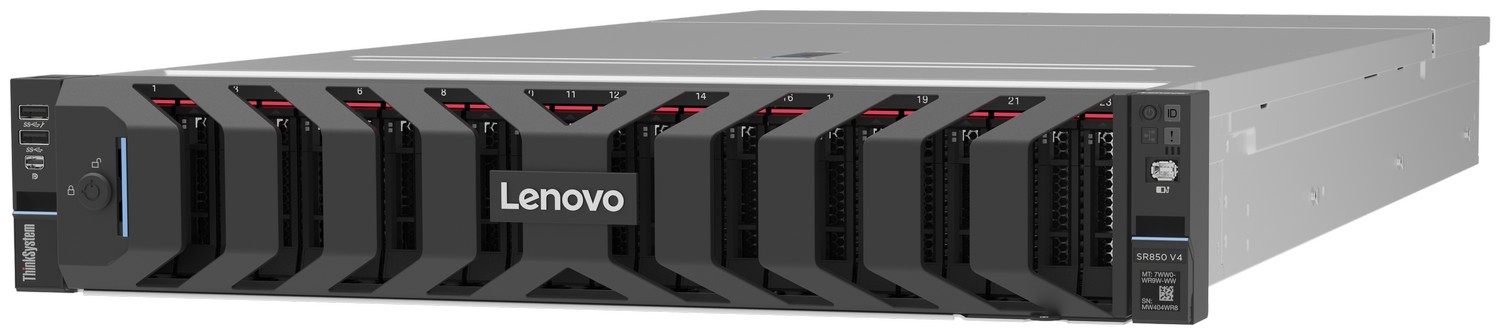
Figure 2. Lenovo ThinkSystem SR850 V4
Business outcome: 2.5x transactional throughput improvement for the ERP database, eliminating batch-processing bottlenecks and supporting real-time supply chain visibility, with the potential to reduce database sprawl and concentrate licensing on a smaller number of productive systems.
Executive questions to answer
- Is the goal maximum performance, minimum licensed cores, operational simplicity, or a balance of all three?
- Which databases benefit from large-memory consolidation?
- What recovery time, recovery point, and availability targets must the design protect?
- Would a capital purchase or TruScale consumption model better align cost with demand?
Best fit: large databases where predictable throughput, memory capacity, and license-aware design matter more than broad horizontal scale.
Scenario C: Virtualization Migration to ThinkAgile HX with SQL availability groups
A regional healthcare network is reassessing their virtualization provider after a shift from perpetual licensing and Support and Subscription renewals to subscription offerings. It wants to move selected SQL workloads to a different virtualization platform without compromising operational resilience or creating another bespoke infrastructure silo.
Lenovo answer
Move suitable SQL Server workloads to ThinkAgile HX with Nutanix. ThinkAgile HX combines Lenovo infrastructure with Nutanix software in a pre-integrated platform, providing a scale-out alternative for virtualized database estates (Lenovo ThinkAgile HX).
Use SQL Server Always On availability groups where application-level high availability is required. Migration planning should validate failover behavior, replication traffic, quorum, backup, and recovery independently.
Expected outcome
In Lenovo testing on a four-node ThinkAgile HX665 V3 Nutanix cluster, SQL Server 2025 OLTP performance scaled by approximately 11.44 times across 12 virtual machines. The same study reported up to 17% decision-support performance improvement over SQL Server 2022 on the tested configuration (Scalable Performance with Microsoft SQL Server 2025 on Lenovo ThinkAgile HX665 V3; AMD SQL Server 2025 on ThinkAgile HX brief).
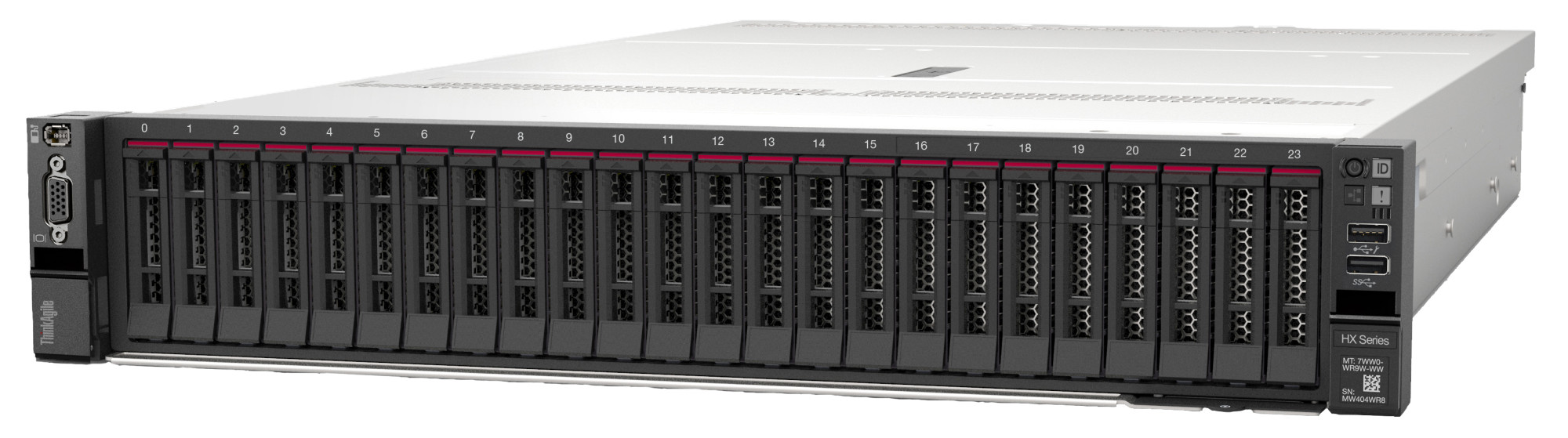
Figure 3. Lenovo ThinkAgile HX665 V3
Business outcome: A measured path off their current virtualization provider for selected SQL workloads, with demonstrated scale-out capability and application-level availability designed around business recovery requirements.
Executive questions to answer
- Which virtual SQL workloads are portable, and which have hidden dependencies?
- What is the current subscription exposure after applying the new licensing fees?
- Which databases require SQL availability groups versus platform-level recovery?
- How will the migration sequence protect service levels and rollback options?
Best fit: Organizations seeking a Nutanix operating model and a phased, evidence-based alternative for virtualized SQL estates.
Conclusion
Your SQL Server 2016 and 2019 environments are on a ticking clock. The transition to SQL Server 2025 is an opportunity to lower costs, eliminate virtualization lock-in, and make your data AI-ready.
Here is why Lenovo is different for SQL Server solutions:
- Microsoft-validated hybrid infrastructure: ThinkAgile MX V4 is a Microsoft Azure Local Premier Solution, Microsoft's highest category of validation and testing (Simplifying Modern Virtualization with Azure Local using Hyper-V/S2D on ThinkAgile MX V4 Series).
- One Tier-1 portfolio across three leading HCI ecosystems: Lenovo offers ThinkAgile MX for Microsoft, VX for VMware, and HX for Nutanix, allowing the platform strategy to follow business requirements rather than vendor lock-in.
- World-record database performance: ThinkSystem SR655 V3 delivered 18,682.14 tpsE, the world's number-one overall TPC-E performance result, using SQL Server 2022 Enterprise (ThinkSystem SR655 V3 Sets 2 World Records with New TPC-E Benchmark Result).
- Microsoft licensing through one provider: Lenovo is a Microsoft Cloud Solution Provider and authorized Microsoft reseller, enabling a single-vendor experience for infrastructure, cloud services, and software subscriptions (Lenovo Microsoft Alliance).
- Flexible consumption with TruScale: Lenovo TruScale IaaS brings cloud-like, pay-as-you-go economics to infrastructure deployed behind your organization's firewall (Lenovo TruScale Infrastructure as a Service).
For More Information
To learn more about running Oracle Database 23ai on Lenovo ThinkAgile VX and FX V4, contact your Lenovo representative or Lenovo Business Partner, or visit the resources below.
References:
- Microsoft SQL Server 2025 on Lenovo ThinkAgile MX650 V4
https://lenovopress.lenovo.com/lp2408-microsoft-sql-server-2025-on-lenovo-thinkagile-mx650-v4 - Reference Architecture: Microsoft SQL Server on Azure Local with ThinkAgile MX650 V3
https://lenovopress.lenovo.com/lp1876-reference-architecture-sql-server-on-azure-local-with-mx650-v3 - Reference Architecture: Microsoft SQL Server
https://lenovopress.lenovo.com/lp1075-microsoft-sql-server-reference-architecture - Microsoft Software Solution Product Guide
https://lenovopress.lenovo.com/lp1079-microsoft-software-solution-product-guide - Microsoft SQL Server Database
https://lenovopress.lenovo.com/solutionbrief/sb0007-sql-server-database-solution-brief - ThinkSystem SR655 V3 Sets 2 World Records with New TPC-E Benchmark Result
https://lenovopress.lenovo.com/lp2214-sr655-v3-tpc-e-benchmark-result - Microsoft SQL Server
https://lenovopress.lenovo.com/software/database/sql - Lenovo Sales Portal SQL hub (Lenovo authentication may be required)
https://www.lenovosalesportal.com/top-resources.aspx?c=1482&nv=76718
Authors
Alejandro Perez is a WW Enterprise IT Solution Manager within Lenovo’s Infrastructure Solutions Group (ISG). He leads the adoption and integration of Enterprise Infrastructure solutions, serving as the Subject Matter Expert for targeted solution architectures. He collaborates with organic and 3rd party SW ecosystem partners to drive innovation and contribute to the company's success. With over 20 years of experience in the IT industry, he has a strong background in Edge Computing, Business Development, and SAP HANA. He is passionate about bringing new technologies to the market and developing new solutions for regional markets.
Trademarks
Lenovo and the Lenovo logo are trademarks or registered trademarks of Lenovo in the United States, other countries, or both. A current list of Lenovo trademarks is available on the Web at https://www.lenovo.com/us/en/legal/copytrade/.
The following terms are trademarks of Lenovo in the United States, other countries, or both:
Lenovo®
Lenovo TruScale®
ThinkAgile®
ThinkSystem®
TruScale®
XClarity®
The following terms are trademarks of other companies:
AMD® is a trademark of Advanced Micro Devices, Inc.
Microsoft®, Azure®, Hyper-V®, and SQL Server® are trademarks of Microsoft Corporation in the United States, other countries, or both.
TPC® and TPC-C® are trademarks of Transaction Processing Performance Council.
Other company, product, or service names may be trademarks or service marks of others.
Configure and Buy
Please select a locale
Full Change History
Course Detail
Employees Only Content
The content in this document with a is only visible to employees who are logged in. Logon using your Lenovo ITcode and password via Lenovo single-signon (SSO).
The author of the document has determined that this content is classified as Lenovo Internal and should not be normally be made available to people who are not employees or contractors. This includes partners, customers, and competitors. The reasons may vary and you should reach out to the authors of the document for clarification, if needed. Be cautious about sharing this content with others as it may contain sensitive information.
Any visitor to the Lenovo Press web site who is not logged on will not be able to see this employee-only content. This content is excluded from search engine indexes and will not appear in any search results.
For all users, including logged-in employees, this employee-only content does not appear in the PDF version of this document.
This functionality is cookie based. The web site will normally remember your login state between browser sessions, however, if you clear cookies at the end of a session or work in an Incognito/Private browser window, then you will need to log in each time.
If you have any questions about this feature of the Lenovo Press web, please email David Watts at dwatts@lenovo.com.


